
European Commission President Ursula von der Leyen has warned that the European Union’s trade relationship with China has become seriously imbalanced. In her 2026 State of the Union address to the European Parliament on 16 September 2026, she stated that the EU’s trade deficit with China had reached approximately €1 billion per day, describing the situation as having reached a “tipping point.” She linked the imbalance to growing pressure on European manufacturing and called for concrete measures to rebalance the relationship. (EU Commission Cyprus). The figure is not simply a statement about one day’s imports and exports. It is a way of expressing the scale of the annual EU goods trade deficit with China. Eurostat reports that in 2025 the EU exported about €199.6 billion of goods to China but imported €559.4 billion, producing a deficit of approximately €359.8 billion. Dividing that annual deficit by 365 days gives approximately €986 million per day, which explains von der Leyen’s rounded figure of €1 billion per day. (European Commission).
In the EU-China case, the 2025 figures were approximately:
| Indicator | 2025 value |
| EU exports of goods to China | €199.6 billion |
| EU imports of goods from China | €559.4 billion |
| EU goods trade deficit | €359.8 billion |
| Average deficit per day | ≈ €986 million |
| Von der Leyen’s rounded description | ≈ €1 billion/day |
However, it is important to differentiate trade in goods from the broader economic relationship. The EU also exports services to China. In 2025, the EU recorded a €21.3 billion surplus in servicestrade with China. Consequently, the €1 billion-a-day figure principally refers to the goods trade imbalance, rather than meaning that the EU loses €1 billion in every aspect of its economic relationship with China every day. (Trade and Economic Security). This indicates that Chinese goods exports to Europe have grown substantially faster than European goods exports to China. China was the EU’s fourth-largest export destination for goods in 2025. (Consilium).
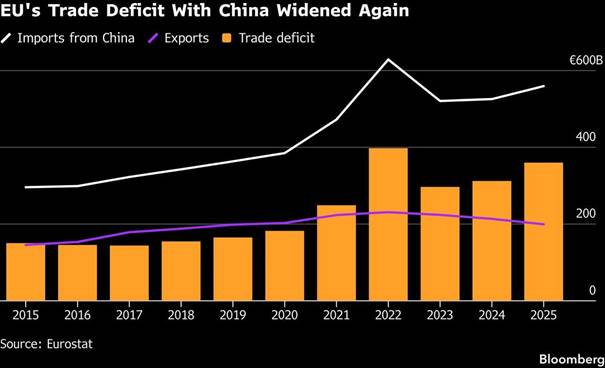
This shows that the imbalance is not primarily the result of one product or one year. It reflects a longer-term structural difference in the two economies’ trading patterns. In 2025, 97.3% of EU imports from China consisted of manufactured goods. Machinery and vehicles accounted for 54.4% of EU imports from China, followed by other manufactured products and chemicals. (Trade and Economic Security) while, in 2025, the EU exported approximately €199.6 billion in goods to China. Important export categories included machinery and mechanical equipment; electrical machinery; motor vehicles; medical and precision instruments; pharmaceutical products. Machinery and mechanical appliances were the largest export category at approximately €45.3 billion, followed by electrical machinery at about €29.0 billion. Vehicles accounted for approximately €16.4 billion, while pharmaceutical products were worth approximately €13.6 billion. (European Commission). Therefore, the EU-China relationship is not simply a story of Europe buying Chinese products. European companies remain major exporters to China, particularly in technologically sophisticated and industrial sectors. The issue was identified by EU policymakers is the large difference between the value of imports and exports.
So, Von der Leyen’s concern was not only the deficit but the pressure it is contributing to European industries and described what she called a “second China shock.” She associated this with deindustrialisation in European industrial communities. (EU Commission Cyprus). However, EU acknowledged the strategic important of China to its trade though, Von der Leyen stated that the EU would use the tools available to it to seek a more balanced relationship with China. (Reuters) Trade-defence measures which can investigate whether imports are benefiting from practices that disadvantage European producers and can impose measures where EU law and international trade rules permit. Also, Europe is seeking alternative suppliers and markets so that individual countries do not become excessively important for strategically important products. Another element is strengthening European production capacity in strategic industries. The Commission is proposing mechanisms for purchasing and stockpiling important raw materials to reduce vulnerability to supply disruptions. (EU Commission Cyprus). At the same time, Brussels continues to engage Beijing diplomatically and commercially. EU officials have indicated that negotiations should produce tangible results on the trade imbalance. (Reuters). At the same time, Beijing has historically objected to European trade restrictions when it considers them discriminatory. This creates a negotiation dynamic in which both sides have economic incentives to maintain trade but disagree about market access, industrial subsidies, competition and regulatory conditions. Though, EU market access is still relevant to china.
Written by
Tochukwu Nicholas Ugwu
