Elon Musk’s Tesla has launched an increasingly aggressive campaign to secure wider European approval for its Full Self-Driving (FSD) Supervised technology, arguing that regulatory delays are preventing motorists from accessing technology that could reduce road deaths. However, a new investigation by Reuters says Tesla’s safety evidence does not substantiate its strongest claims, particularly the suggestion that European regulators are effectively causing deaths by delaying approval. Seven traffic-safety researchers who examined Tesla’s European safety research for Reuters concluded that the company’s data does not demonstrate that FSD prevents fatal crashes. (Reuters). The dispute has consequently become much bigger than a technical disagreement over autonomous driving. It now concerns how regulators evaluate emerging vehicle technology, how companies use social media to influence public opinion, and whether commercial pressure can weaken independent safety oversight. However, Tesla is seeking broader European authorization for its Full Self-Driving (Supervised) system. Despite its name, the technology is not fully autonomous. Tesla itself requires the driver to remain attentive and ready to intervene. The system can perform many driving functions, but responsibility remains with the human driver. This distinction is important because European regulators classify the relevant technology as a driver-assistance system rather than a vehicle that can independently perform the entire driving task.
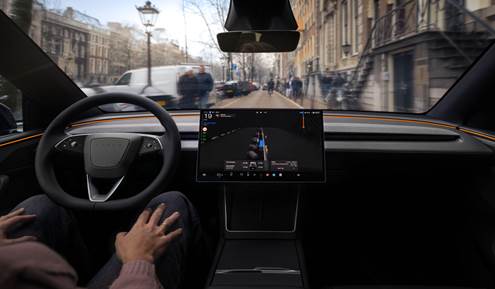
Tesla Self Driving
The United Nations Economic Commission for Europe (UNECE) describes Driver Control Assistance Systems under Regulation No. 171 as systems that assist with longitudinal and lateral control while not taking over the entire driving task. Drivers remain responsible for monitoring the environment and system and must be able to intervene. (UNECE). European approval is strategically important to Tesla. The company has faced increasing competition from established European automakers and rapidly expanding Chinese electric-vehicle manufacturers. Reuters says Tesla is trying to regain European market share after significant sales declines. FSD could give Tesla another selling point because advanced driver-assistance technology is increasingly becoming a competitive feature in the EV market. (Reuters). Tesla’s ambitions go beyond individual national approvals. According to Reuters, the Netherlands provided a particularly important regulatory breakthrough because its approval could help open the way toward a wider European decision involving regulators from the EU’s 27 member states. (Reuters). Reuters reported that Tesla had already received national approvals in several European countries, including the Czech Republic, Belgium and Denmark, with other countries also moving forward. (Reuters).
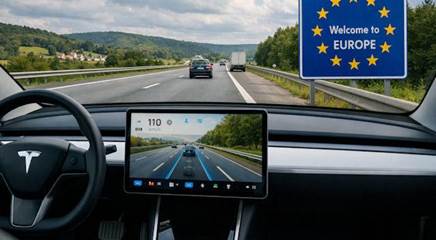
Tesla European Regulatory Delay
Tesla’s campaign has relied heavily on the argument that delaying FSD prevents Europeans from benefiting from technology that could make driving safer. In September, Tesla published its European safety research and argued that approximately 53 people die on European roads each day, suggesting that many of these deaths could be prevented by technologies already available. Tesla characterized the safety benefit as being “locked behind bureaucracy.” (Reuters). Musk has made similar arguments. After French Transportation Minister Philippe Tabarot said France could not support EU-wide expansion of FSD because of safety concerns, Musk responded on X that delaying FSD approval in France would “cost lives.” (Reuters). The strategy therefore reframes the regulatory debate. Regulators are delaying a potentially life-saving technology. The technology’s safety has not been established sufficiently to justify claiming that regulators are responsible for road deaths.
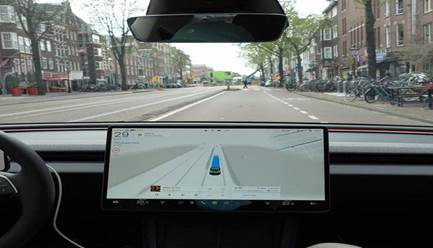
Tesla Full self Driving
According to Reuters, Tesla’s European research could not establish a reliable difference in actual crash rates between FSD and conventional driving. Tesla’s FSD-equipped vehicles had been driven only tens or hundreds of thousands of miles in the relevant European sample, while manually driven Teslas had accumulated hundreds of millions of miles. Researchers told Reuters that this disparity made it impossible to draw a robust comparison of crash rates. (Reuters). Instead, Tesla used various driving behaviours as surrogate indicators of safety such as horn honking; low indicator/blinker use; rapid acceleration; rapid deceleration; automatic emergency braking; hard cornering. The idea is that dangerous driving behaviours can sometimes act as indicators of increased crash risk. But the researchers interviewed by Reuters said the relationship between several of these behaviours and actual crashes is not sufficiently established to support Tesla’s much stronger claims about preventing deaths. (Reuters). Consequently, A surrogate measure is not the same thing as the outcome researchers ultimately care about. Hard braking → may indicate a dangerous situation → may correlate with crashes does not automatically establish: FSD reduces hard braking → therefore FSD prevents fatal crashes. There can be many explanations for a vehicle braking sharply that have nothing to do with a crash. Likewise, horn use and indicator usage can be affected by local driving culture, traffic conditions, road design and individual driving habits. Interestingly, Reuters reports that Tesla’s European study itself contains a warning. The company says its comparison of FSD driving and human driving behaviour should not be interpreted as a causal estimate. A causal estimate would attempt to establish that FSD itself caused a particular improvement in safety. Without such evidence, observing that FSD-equipped vehicles behave differently from manually driven vehicles does not necessarily prove that FSD will reduce deaths. The claim of full self-driving has communication lapses as the name can suggest to ordinary consumers that the vehicle can drive itself without supervision. But Tesla’s system is still supervised. UNECE’s description of Driver Control Assistance Systems makes the distinction clear: these systems assist the driver but do not take over the complete driving task. The driver must continue monitoring the road and remain capable of intervention. (UNECE). Norwegian road-safety officials have also expressed concern about the terminology. Reuters quoted Norwegian Public Roads Administration chief engineer Stein-Helge Mundal as warning that the name could cause drivers to believe the system can do more than it actually can. (Reuters).This is particularly important because overconfidence in automation can itself create a safety risk. Moreover, Reuters’ investigation found that Tesla’s strategy has included direct engagement with regulators as well as social-media mobilisation. Musk has encouraged Tesla customers to pressure European authorities. At Tesla’s annual shareholder meeting, Musk reportedly said that people’s lives were at stake and that pressure from European customers on regulators to approve FSD would be appreciated. (Reuters). Tesla supporters subsequently contacted European regulators. Reuters found communications from Tesla enthusiasts in countries including Sweden and Norway arguing that delaying approval would result in unnecessary deaths. One Norwegian regulatory official described the situation as a pressure strategy that required authorities to devote considerable effort to responding to what officials considered misleading claims. (Reuters).