Hundreds of protesters have established tent encampments in Madrid’s central Puerta del Sol, turning one of Spain’s most prominent public squares into the centre of a growing protest over housing affordability, evictions and the shortage of affordable homes. The demonstrations have also spread to Barcelona, reflecting concerns that extend beyond Madrid and affect renters and prospective homeowners across Spain. (Al Jazeera). The immediate trigger was the highly publicised eviction of 87-year-old María del Carmen Abascal, known as Maricarmen, from the Madrid apartment where she had lived for more than seven decades. Her case has become a symbol for housing activists who argue that Spain’s housing system is increasingly unaffordable for ordinary households. (AP News). Furthermore, The protests intensified after police carried out the eviction of Maricarmen Abascal on 23 September 2026. Abascal had lived in the Madrid property for about 71 years. According to reporting on the case, the building was acquired by an investment company in 2018. Her rent, previously around €500 per month, was subsequently raised substantially. During negotiations, the requested rent was reduced from €2,650 to €1,650 per month, but this was still beyond what she could afford on her pension. (ABC News). The eviction generated particularly strong public reaction because images showed the elderly woman being removed from the property on a stretcher while police dealt with demonstrators outside. However, Hundreds of supporters had gathered to try to prevent the eviction. Reports said clashes occurred between protesters and police, with riot police using force to clear access to the building. (The Guardian). Her eviction subsequently became the immediate catalyst for a much broader housing protest.
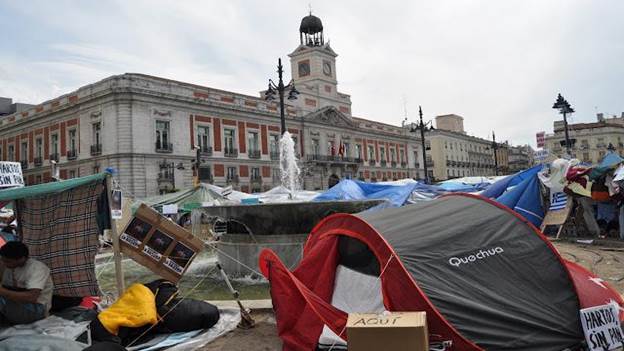
The camping of protesters
With the large demonstration in Madrid, protesters began establishing tents at Puerta del Sol, one of the capital’s best-known public spaces. The encampment rapidly expanded. The Guardian reported on 29 September that organizers said the camp had grown from approximately 10 tents to more than 300, while other reports put the number of tents and participants at somewhat different levels. Anadolu Agency reported around 350 tents and approximately 600 people remaining at the camp on Monday. (The Guardian). The differences in estimates reflect the rapidly changing nature of the demonstration and the fact that different organizations are counting tents and participants at different times.
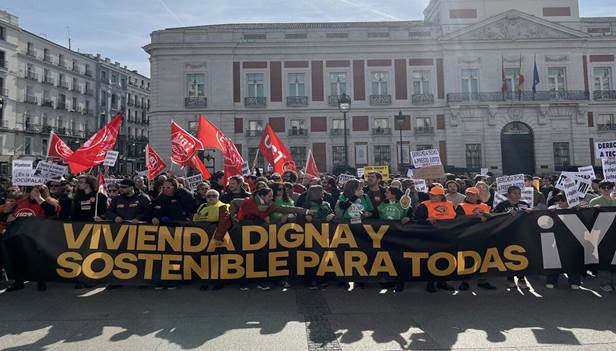
Protesters for increased house Rents
The symbolism of Puerta del Sol is also important. The square was a major gathering point during Spain’s 2011 Indignados movement, when protesters occupied the area during demonstrations against austerity, unemployment and economic inequality. The new housing encampment has therefore drawn comparisons with that earlier protest movement. (Yahoo News Malaysia).
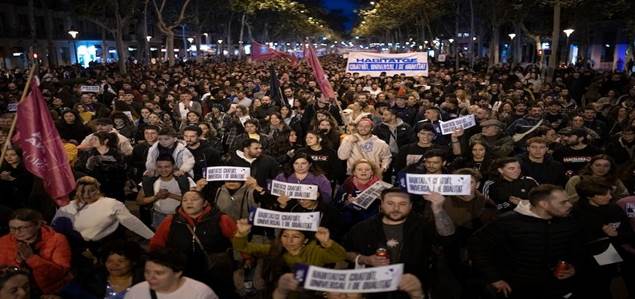
Protesting continued for days.
The protesters’ demands center on the idea that housing should be accessible as a basic social right rather than being treated primarily as an investment asset. The Madrid Tenants’ Union and other housing organizations have called for measures including: stronger protection against evictions; restrictions on rent increases; longer or indefinite rental contracts; regulation of room rentals; greater protection for vulnerable tenants; action against speculative investment in residential property; greater availability of affordable housing; and measures to prevent tenants from being priced out of their homes. The exact demands vary among organizations, but the common theme is that government intervention should address the growing gap between housing costs and household incomes. (Anadolu Agency). Spain’s housing difficulties are not simply about rents increasing in a few neighbourhoods. They are connected to a wider supply-and-demand imbalance. Reuters reported that Spain has a housing deficit of approximately 750,000 homes, according to the country’s central bank, and that the shortage could rise to more than one million homes by 2028 if construction does not increase sufficiently. (Reuters). At the same time, only around 120,000 homes are being constructed annually, according to Reuters’ reporting. That is substantially below the construction rate recorded before the 2008 financial crisis. (Yahoo News Malaysia). This shortage puts pressure on both the rental and purchase markets. When the supply of homes fails to keep pace with demand, prospective tenants compete for a limited number of properties. This can contribute to higher rents, particularly in major cities where employment, universities, tourism and population growth attract large numbers of people. However, Madrid and Barcelona are more affected because they are Spain’s most economically important cities and have experienced substantial pressure on their housing markets. The shortage is particularly severe in attractive urban areas where demand comes from several sources such as Local residents, young people, Students, Tourism, Population growth, Investment. The combination makes the problem particularly visible in Madrid and Barcelona. The movement has not remained confined to Madrid. Demonstrations were reported in Barcelona, where protesters called for political action over housing costs. Reuters footage showed demonstrators blocking part of Barcelona’s Diagonal Avenue during a protest on 28 September. (Yahoo News Malaysia). Barcelona has already been at the center of debates over rent regulation, tourist accommodation and housing affordability. The spread from Madrid to Barcelona is significant because it indicates that the demonstrations are not simply a reaction to one individual eviction. Instead, the Abascal case has become a focal point for wider concerns about housing conditions throughout Spain. An important development occurred after the protests began. On 28 September, Reuters reported that Abascal had reached an agreement with the landlord that would allow her to return to the apartment under a new eight-year lease, with rent broadly similar to what she had previously been paying. Her lawyer described the agreement as an unusual reversal after an eviction had already been carried out. (Reuters). Abascal had been hospitalized after the eviction. Although the agreement potentially resolves her immediate housing situation, it has not ended the broader demonstrations because protesters view her case as part of a much larger housing problem.