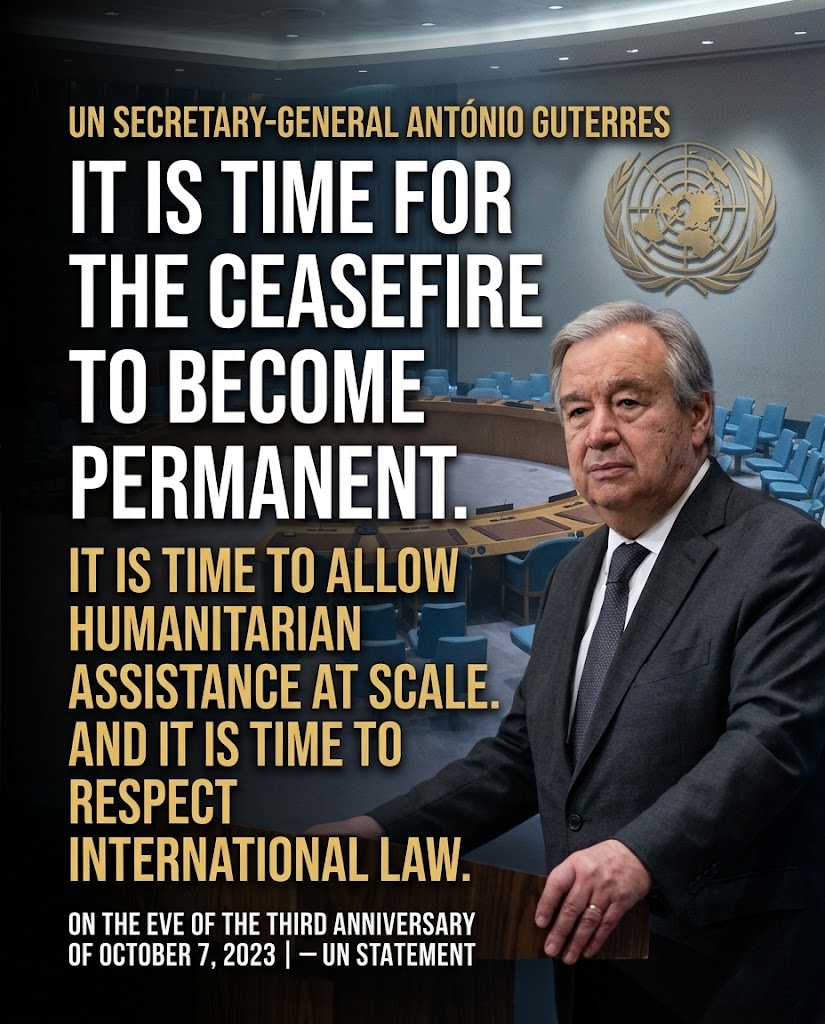
UN Secretary-General António Guterres has called for a permanent ceasefire in Gaza, issuing a stark message on the eve of the third anniversary of the October 7, 2023 attacks that triggered the war. In a statement released on Monday, Guterres said the horrors of those attacks must never be repeated and that the ensuing hostilities must end, describing the conditions civilians continue to endure as intolerable (Xinhua, 2026).
“It is time for the ceasefire to become permanent. It is time to allow humanitarian assistance at scale. And it is time to respect international law,” Guterres said (BSS/AFP, 2026).
The UN chief acknowledged the October 7 attack as “abhorrent” for killing more than 1,200 Israelis and foreign nationals and taking 251 hostages. He also said Palestinians in Gaza have faced “massive loss of life, displacement and destruction,” adding: “Their suffering, too, demands an end, now” (RTE, 2026).
The Ceasefire That Hasn’t Delivered
The October 2025 ceasefire, announced by US President Donald Trump, was the biggest diplomatic breakthrough since the war began. It secured the release of the remaining Israeli hostages and sharply reduced fighting (CGTN, 2026). But Guterres was blunt about its limits. The ceasefire “brought some relief,” he said, but “it has yet to deliver security, adequate humanitarian assistance or a credible path to recovery and peace” (RTE, 2026).
The numbers bear that out. Since the October 2025 ceasefire, Israeli forces have killed at least 1,460 Palestinians and injured 5,116 others, according to Gaza’s Health Ministry (Anadolu Agency, 2026). On Tuesday alone, Israeli fire killed two Palestinians and injured three others, including a man targeted in a drone strike near the Municipal Park in Gaza City and a 34-year-old who died from wounds sustained in a strike in Khan Younis (Anadolu Agency, 2026).
Overall, more than 74,000 Palestinians have been killed since October 2023, with over 175,000 injured. About 90 percent of Gaza’s infrastructure has been destroyed (Anadolu Agency, 2026). UN agencies estimate that around 2.1 million people, the entire population of Gaza, have been displaced, including 20,000 children among the dead (QNA, 2026).
A Humanitarian Crisis Worsening by the Day
The humanitarian situation continues to deteriorate. Daily hot meal production and household parcel distributions will shrink significantly from October onwards due to funding shortfalls, the Food Security Sector warns (ReliefWeb, 2026). Over 13 percent of Gaza’s population lives in flood-prone displacement sites or unsafe buildings, with about 279,000 people sheltering in 400 flood-prone sites and over 2,300 in buildings requiring demolition (ReliefWeb, 2026).
The Norwegian Refugee Council warned that 1.65 million people in Gaza face a fourth winter in worn-out tents and war-damaged buildings exposed to rain and cold. Israeli authorities allow just 15 trucks carrying items designated as “dual-use” to enter Gaza from Jordan each week, including tents and tarpaulins. At that pace, it would take more than seven months to bring in the 500 truckloads of shelter items currently in the pipeline (NRC via ReliefWeb, 2026).
“Palestinians in Gaza cannot be expected to survive another winter in worn and torn tents that were never designed to withstand these conditions,” said NRC Secretary General Jan Egeland. “This is not an unavoidable natural disaster. It is a manmade humanitarian crisis because life-saving shelter aid is blocked by the occupying power” (NRC via ReliefWeb, 2026).
Funding shortfalls are compounding the crisis. Donors have provided only 34 percent of the $283 million needed for the minimum winter shelter response, leaving a $186.6 million gap. Current stocks can provide only partial assistance to around 52,000 families, while nearly 300,000 families need help (NRC via ReliefWeb, 2026).
The Political Impasse
The ceasefire has done little to resolve the fundamental questions that keep the war alive. Israel refuses to withdraw its soldiers until Hamas’ disarmament has been verified. Hamas has advocated for gradual disarmament rather than immediate and unilateral surrender of its arsenal (RTE, 2026).
The sequencing problem is central. Israel wants guarantees that Hamas cannot rebuild before giving up control of territory, while Hamas has little incentive to surrender its main leverage without guarantees that Israel will withdraw and not resume the war (CGTN, 2026).
A US-backed roadmap announced in July seeks to bridge the gap by linking a phased Israeli withdrawal with Hamas’ disarmament, an international stabilisation force, and a Palestinian technocratic administration. But agreeing to a framework has proven far easier than implementing one (CGTN, 2026).
The question of who governs Gaza remains unresolved. Hamas has retained influence and reportedly collected taxes and paid salaries in parts of the enclave, while Israel has sought to prevent the group from returning to power. That leaves no clear political authority capable of taking over (CGTN, 2026).
Rebuilding adds another dilemma. Gaza’s devastated infrastructure needs massive investment, but donors need a credible security and governing structure before committing. UN figures show about 65 percent of Gaza’s land is inaccessible or severely restricted, leaving humanitarian agencies to work in the remaining 35 percent, which is already overcrowded (CGTN, 2026).
What Guterres Is Asking For
Guterres urged all parties to implement their commitments in full and advance to the next phase of the ceasefire, in line with UN Security Council Resolution 2803. He stressed the need to build a political path to lasting peace across the entire region and reaffirmed the UN’s unwavering commitment to these imperatives (QNA, 2026).
“Let this anniversary mark not only another year of mourning, but also a renewed determination to build a different future: one in which Israelis and Palestinians can live side by side in peace and security, with their rights, dignity, and aspirations fulfilled” (BSS/AFP, 2026).
The Road Ahead
Three years after the October 7 attacks, the war in Gaza has largely subsided under a fragile ceasefire. But the hardest questions remain unanswered. Israel and Hamas are locked in a dispute over the sequencing of withdrawal and disarmament. No credible governing authority is in place. Reconstruction cannot begin without a political settlement. And the humanitarian crisis is worsening as winter approaches.
Guterres’s call for a permanent ceasefire is the clearest statement yet from the UN’s top official that the current arrangement is not working. Whether it translates into action depends on the parties, the mediators, and whether the international community is willing to back its words with pressure.
For the 1.65 million Palestinians facing another winter in tents, the anniversary is not a moment for reflection. It is another day of survival.