
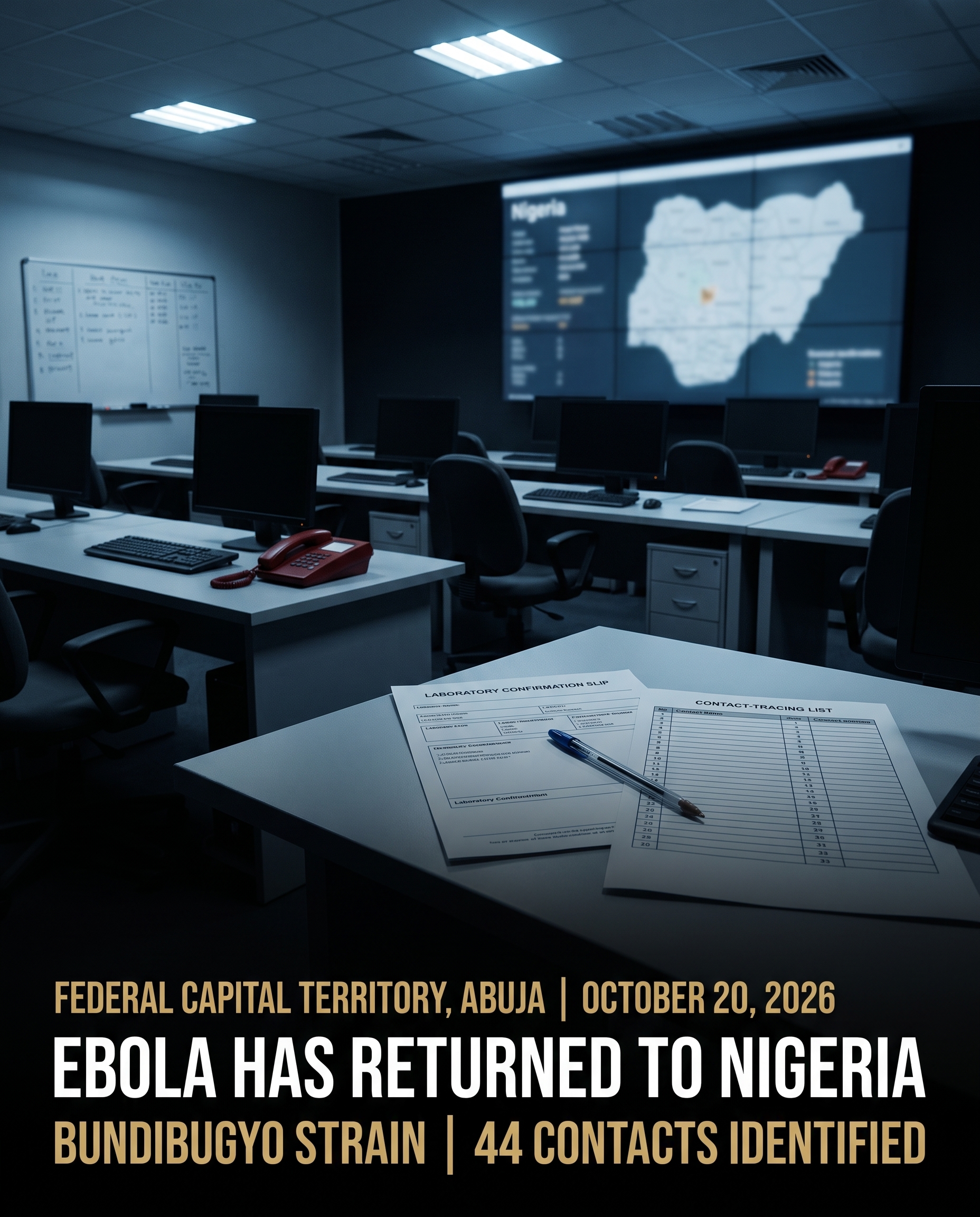
Nigeria has confirmed a case of Ebola Virus Disease in Abuja, the Federal Capital Territory. The patient is a woman who recently arrived in the country on an international flight from Uganda. She is currently in isolation and receiving medical care.
The confirmation came on Tuesday, October 20, 2026, from the Coordinating Minister of Health and Social Welfare, Prof. Muhammad Ali Pate. The Federal Ministry of Health and Social Welfare, the Nigeria Centre for Disease Control and Prevention, and the FCT Health Services Secretariat are working together to contain the infection and prevent further spread.
This is Nigeria’s first confirmed Ebola case of the current regional outbreak. It was not unexpected.
What Happened
The patient began showing symptoms on October 7. She was admitted to a private hospital in Abuja on October 11, where she received treatment for several days before the diagnosis was confirmed on October 20. That gap between admission and diagnosis is significant. Ebola symptoms in the early stages are notoriously non-specific. Fever, headache, weakness, and vomiting look like malaria, typhoid, or Lassa fever. Nigerian doctors see those symptoms every day.
By the time the diagnosis was confirmed, the patient had been in a private hospital for nine days. Public health teams have now identified 44 close contacts, including healthcare workers, patients, caregivers, and travel contacts. The hospital where she was treated is receiving immediate support to strengthen infection prevention and control measures.
The government has placed all public and private healthcare facilities nationwide on high alert. Healthcare workers have been directed to maintain a high index of suspicion, promptly isolate suspected cases, and report them immediately to public health authorities.
The Strain Matters
The current outbreak in East Africa is driven by the Bundibugyo ebolavirus. This is not the Zaire strain that the world knows from the 2014 West African outbreak and from most Ebola vaccine trials.
The distinction is critical. As the NCDC warned in a public advisory in May 2026, there are currently no approved vaccines or specific treatments available for Bundibugyo Ebola virus disease. Existing Ebola vaccines and monoclonal antibody treatments are primarily directed against the Zaire ebolavirus and should not be relied upon as countermeasures for this outbreak strain.
Control of the outbreak therefore depends largely on rapid public health measures: early detection, prompt isolation, strict infection prevention and control, contact tracing, safe burial practices, and strong surveillance systems.
The Bundibugyo outbreak in the Democratic Republic of Congo and Uganda had, as of the NCDC’s May advisory, recorded 1,077 suspected cases and 247 deaths, with a case fatality rate as high as 24.6 percent. The World Health Organization declared it a Public Health Emergency of International Concern on May 17, 2026.
Nigeria Was Preparing
This case did not catch Nigeria entirely off guard. The NCDC classified the risk of importation as high months ago, citing increasing regional transmission, international travel, porous land borders, and the overlap of early Ebola symptoms with malaria and Lassa fever.
In June 2026, President Bola Tinubu approved the establishment of a Presidential Task Force on Ebola and the release of N10 billion as emergency intervention funding to strengthen the NCDC’s operational preparedness. Emergency Operations Centres across states were placed on standby. Readiness assessments were completed in 549 health facilities across 32 states and the FCT, and 17 designated treatment centres were evaluated for screening capacity, isolation readiness, and treatment preparedness.
The NCDC Director-General, Dr Jide Idris, said in June that Nigeria’s preparedness for a potential Ebola outbreak stood at 59 percent. “You can’t be 100 percent prepared,” he said, “but the essence is that we keep preparing because things change”.
Then Kenya confirmed an imported case in early October. The NCDC raised vigilance again on October 6, stressing that there was no confirmed case in Nigeria at that time. Two weeks later, the virus arrived.
The 2014 Precedent
Nigeria has faced Ebola before. In 2014, an infected traveller from Liberia, Patrick Sawyer, arrived in Lagos and triggered an outbreak that could have been catastrophic. Nigeria contained it. The response involved rapid case identification, isolation, contact tracing, and coordinated public health interventions.
That success is the reason Nigerian health officials are urging calm. Prof. Pate said the country has the experience and public health systems required to respond to the current case, but stressed that preventing further transmission will require public cooperation.
The 2014 response worked because Nigerian doctors and public health workers moved fast. The question now is whether the system is as sharp as it was twelve years ago. The fact that the patient spent nine days in a hospital before Ebola was suspected is not a reassuring signal.
What Nigerians Need to Know
Ebola is not airborne. It spreads through direct contact with the blood or body fluids of an infected person who is sick or has died, or through contact with contaminated materials and surfaces. People infected with the virus do not transmit it before symptoms develop. The incubation period ranges from two to 21 days.
The symptoms to watch for are fever, severe weakness, headache, vomiting, and diarrhoea, particularly in anyone who may have been exposed to the infection. Anyone who develops symptoms should avoid close contact with others and call public health authorities for guidance before visiting a healthcare facility.
The government has advised regular handwashing and avoiding contact with the blood or body fluids of anyone suspected of having Ebola. People contacted by public health teams during the tracing exercise, including potentially exposed airline passengers, are urged to provide the required information and comply with official guidance.
The NCDC’s toll-free call centre is available 24 hours a day on 6232 for information or to report a suspected case.
What Happens Next
The next 21 days are critical. That is the maximum incubation period for Ebola. If the 44 identified contacts remain symptom-free through that window, the immediate risk of a wider outbreak diminishes significantly. If any of them develop symptoms, the contact tracing net will need to expand.
The government has activated the Presidential Task Force on Ebola Virus Disease, and investigations are ongoing. The World Health Organization and Africa CDC are likely to be involved in verification and support.
For Nigerians, the message from health authorities is consistent: remain calm, but remain vigilant. Ebola is a terrifying disease. It is also one that Nigeria has beaten before. The difference this time is the strain. There is no vaccine for Bundibugyo. The only tools are speed, isolation, and contact tracing.
The patient is in isolation. The contacts are being monitored. The system is responding. Whether it responds fast enough is the question that will define the next three weeks.


