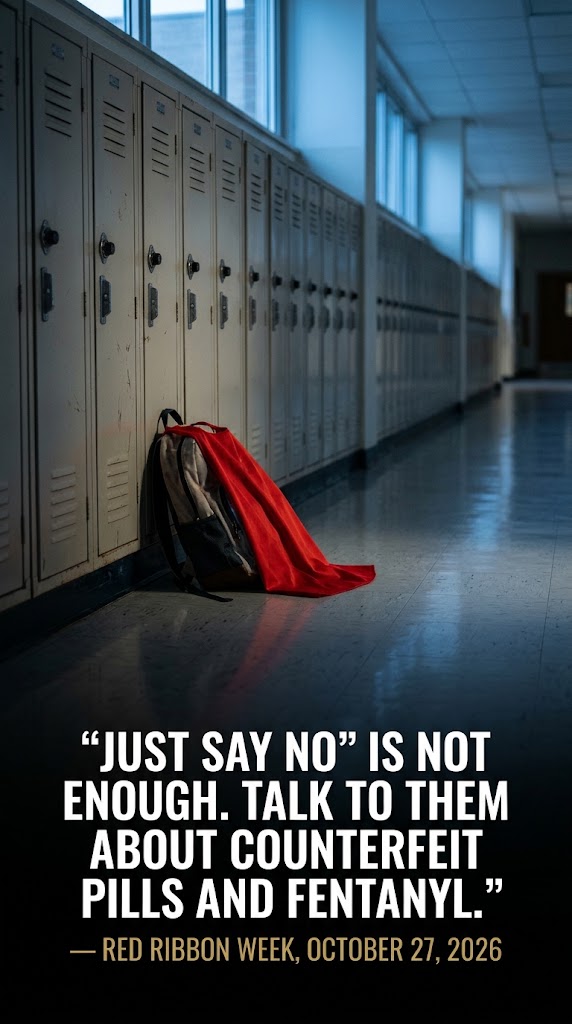
Every year, Red Ribbon Week gives parents and teachers a comfortable entry point. Children wear red on Monday, pyjamas on Tuesday, superhero capes on Wednesday. The theme for 2026 is “Be A Hero. Stay Drug Free!” and Super Hero Day falls on Tuesday, October 27 (Melissa ISD, 2026).
The costumes are the easy part. The harder work is what happens when the cape comes off and a child asks a real question about drugs.
That question is getting harder to answer. The drug supply has changed. The risks have changed. And the prevention messaging that many parents grew up with, the “just say no” model, has been thoroughly discredited by research.
Why “Just Say No” Failed
The Drug Abuse Resistance Education programme, better known as D.A.R.E., was the flagship of American drug prevention for decades. Police officers delivered it in schools. It was based on total abstinence and refusal skills.
A meta-analysis found the programme largely ineffective. One study found that students who completed D.A.R.E. were more likely than their peers to take drugs (APA, 2024). The reasons are not mysterious. Fear-based messaging does not resonate with adolescents. It ignores the real and perceived benefits young people associate with substance use, such as coping with stress or fitting in. And when adults exaggerate or simplify, they lose credibility.
The failure is not just American. An evaluation of the UK’s “Just Say No” campaign found that simplistic “say no” messages were ineffective, and that campaigns focused purely on behaviour change were unlikely to succeed (UK Parliament, 2003). The science is consistent: prevention works when it is honest, sustained, and developmentally appropriate. It fails when it is a slogan.
What Actually Works at Different Ages
The evidence points to a different model. Not one “big talk,” but many small ones. Not fear, but facts. Not a lecture, but a conversation that changes as the child grows.
For younger children, the focus should be on health and safety. The American Academy of Pediatrics recommends talking with children about the risks of substance use as early as age nine (Northborough, 2026). At this stage, the message is simple: medicine only helps the person it is meant for; never take someone else’s medicine; some things are harmful to growing bodies.
For tweens and young teenagers, the conversation shifts. Parents should ask open-ended questions. What have you heard about drugs at school? What have you seen online? What do you think about vaping? The goal is not to interrogate but to listen without judgment, so the child feels safe telling the truth (Prevention Integration Center, 2026).
For older teenagers, the conversation has to acknowledge reality. Some of their peers will use substances. Some will offer them. The most protective thing a parent can do is be clear about expectations while keeping the door open. Research from the HSE in Ireland found that young people are more likely to delay or avoid substance use when parents set clear expectations, talk openly and age-appropriately, take an interest in their lives and friendships, know where they are and who they are with, and model healthy behaviour themselves (HSE, 2026).
That last point matters more than most parents realise. Children watch what adults do. A parent who drinks heavily while telling a child to stay drug-free is not delivering a credible message.
The Fentanyl Problem Changes Everything
The prevention conversation in 2026 cannot be the same one it was five years ago. The drug supply is contaminated.
Fentanyl is a synthetic opioid up to 50 times stronger than heroin and 100 times stronger than morphine. Illegally manufactured fentanyl is routinely pressed into counterfeit pills designed to look like legitimate prescription medications such as Xanax, Percocet, or Adderall (CDC, 2026). From 2020 to 2024, 75 percent of overdose deaths among young people aged 10 to 19 involved fentanyl.
The critical message for teenagers is not “drugs are bad.” It is “you cannot tell the difference.” Fake pills look exactly like real ones. No teenager, and no adult, can identify a counterfeit pill by sight. The only safe medication is one prescribed directly to you and dispensed by a licensed pharmacist (CMH, 2026).
That is a message teenagers can understand. It is concrete. It respects their intelligence. It does not rely on scare tactics. And it is true.
Parents should also know the signs of an opioid overdose and keep naloxone on hand. Naloxone reverses opioid overdoses and is safe and easy to use. Several American states and cities have made it widely available. The principle is simple: if there is a chance a young person in your home could encounter a counterfeit pill, you should be prepared to respond (CDC, 2026).
The Nigerian Reality
Nigeria’s drug problem looks different from America’s, but the prevention principles are the same.
The 2019 UNODC/NDLEA survey found that 14.4 percent of Nigerians aged 15 to 64 had used drugs in the past year. Tramadol, codeine-based cough syrup, and prescription sedatives are among the most commonly misused substances, and the burden falls disproportionately on young people (Punch, 2026). In schools and communities, the names are familiar: Colos, Mkpuru Mmiri, codeine, tramadol, Rohypnol (The Sun, 2026).
The NDLEA has called for a national emergency. Its chairman, Buba Marwa, has warned that substance abuse erases advancement for young people, damages families, and threatens national security (Punch, 2026). At the “Fly Above the High” conference in Abuja in April 2026, experts called for structured drug education for children between the ages of eight and 10, alongside tighter regulation of codeine and tramadol and expanded counselling services.
The Edo State NDLEA command has been taking the message into schools, teaching students what it calls the “Five Ds” for resisting drug use: Delay, Deflect, Decline, Distance, and Disclose (The Sun, 2026).
That framework is closer to what the evidence supports than “just say no.” It gives young people practical scripts for real situations. It acknowledges that pressure happens and prepares them to respond, rather than pretending that a single refusal will end the matter.
What Parents and Teachers Can Do This Week
Red Ribbon Week is a hook, not a solution. The dress-up days give schools a reason to talk about drugs. But the conversation has to continue after the week ends.
Parents can start by asking their children what they learned during Red Ribbon Week. Not in a testing way, but in a curious one. What did they talk about in assembly? What did the superhero theme mean? What questions do they have?
Teachers can move beyond the slogan. Instead of telling students to “be a hero,” they can explain what a hero actually does: a hero asks questions, checks on a friend who is acting differently, refuses to share medication, and knows how to call for help.
And families can set the conditions that research shows actually protect young people. Lock up prescription medications at home. Dispose of unused pills properly. Know where your children are and who they are with. Set clear expectations. Model healthy behaviour. And keep talking, not once, but often.
The red ribbon is a symbol. The conversation is the intervention.