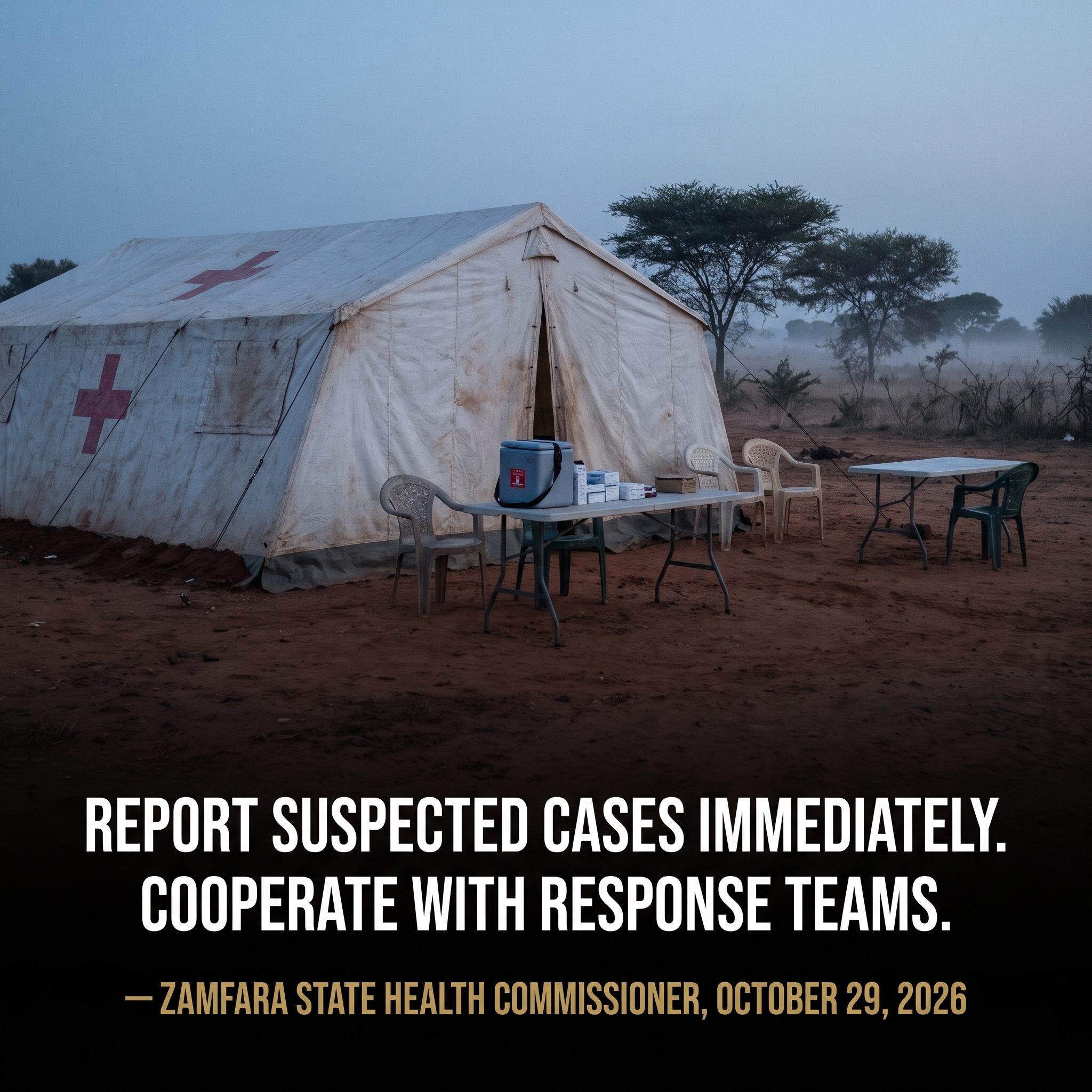
On October 29, 2026, the Zamfara State Government publicly thanked Médecins Sans Frontières for its support in fighting the diphtheria outbreak that has gripped the state since September (Daily Trust, 2026).
The Health Commissioner, Dr Nafisa Muhammad Maradun, made the commendation during a visit to the Infectious Diseases Hospital, where she assessed the response activities MSF has been implementing. She urged residents to cooperate with response teams and to report suspected cases promptly to the nearest health facility (Daily Trust, 2026).
The appreciation is deserved. MSF, working alongside the state Ministry of Health, has been running house-to-house case searches in Gusau Local Government Area since early October. Health teams are going into communities, educating residents on the signs and symptoms of diphtheria, and referring suspected cases to designated treatment centres, including the Infectious Diseases Centre in Damba and the Primary Health Care Centre in Kwata. Patients and caregivers are receiving free healthcare, including food (Voice of Nigeria, 2026).
But the deeper story is not about the response. It is about why the outbreak happened at all.
What Diphtheria Does
Diphtheria is caused by a bacterium called Corynebacterium diphtheriae. It spreads from person to person, mostly through respiratory droplets when an infected person coughs or sneezes. The incubation period is usually two to five days (WHO, 2023).
The symptoms start like a bad sore throat. Fever. Swollen neck glands. Weakness. Then, within two to three days, dead tissue forms a thick, grey coating that can cover the tissues in the nose, tonsils, and throat. This is the pseudomembrane, the signature sign of diphtheria. It can make it hard to breathe and swallow, and in severe cases, it can block the airway entirely (WHO, 2023).
The bacterium also produces a toxin. That toxin can travel through the bloodstream and damage the heart, kidneys, and nerves. Without prompt treatment with diphtheria antitoxin and antibiotics, the disease can be fatal in up to 30 percent of cases (WHO EMRO, 2026).
The warning signs are not subtle, but they are easy to miss in the early stages. A child who cries when trying to swallow. A hoarse voice. A neck that looks swollen. A thick grey patch at the back of the throat. Difficulty breathing. Any of these should prompt immediate medical attention (WHO, 2023).
The Numbers Behind Zamfara’s Outbreak
When Zamfara announced the outbreak in September, it confirmed 44 deaths from 367 clinically suspected cases. More than 300 patients had been treated and discharged. The outbreak was severe enough that the state government extended school resumption by two weeks, because most of the infected patients were school pupils (Daily Nigerian, 2026).
Zamfara is not alone. Nigeria has been battling a persistent diphtheria outbreak since 2022. By March 2026, the country had recorded 65,759 suspected cases and 2,229 deaths. Kano, Bauchi, Katsina, Yobe, Borno, Kaduna, Jigawa, and Plateau States account for 99.1 percent of confirmed cases. Children aged one to 14 years make up 64.8 percent of confirmed cases. And 85.7 percent of them were unvaccinated (PAN, 2026).
The pattern is not random. Diphtheria resurges when immunisation coverage falls. The National Primary Health Care Development Agency reported in October 2026 that 93 percent of children affected by recent outbreaks in Nigeria had not received the full recommended vaccine doses. Some had received no vaccine at all. Others had received only one of the three recommended doses (Premium Times, 2026).
The agency’s Executive Director, Muyi Aina, attributed the gap partly to misinformation and false rumours affecting vaccine uptake in some communities. “The vaccines are available,” he said. “But when people allow misinformation and false rumours to influence their behaviour, they don’t access the vaccines” (Premium Times, 2026).
Why Vaccination Is the Only Real Answer
The diphtheria vaccine is not new. It is included in every country’s essential immunisation programme. The World Health Organization recommends a three-dose primary series starting as early as six weeks of age, followed by three booster doses during childhood and adolescence (WHO, 2023).
The vaccine is safe and effective. Mild side effects like redness at the injection site or a mild fever are normal. Serious side effects are rare (WHO, 2023).
The problem is not the vaccine. It is access, trust, and consistency. Nigeria’s northern states, including Zamfara, have large zero-dose and undervaccinated populations. Insecurity, displacement, and disruptions to vaccine supply chains complicate outbreak control efforts. Subnational inequities in immunisation coverage mean that children in some communities are protected while children in others are not (ReliefWeb, 2026).
The MSF-supported house-to-house campaign in Gusau is doing exactly what needs to be done: finding cases early, referring them for treatment, and educating communities. But house-to-house searches are a response to an outbreak. They are not a substitute for routine immunisation that prevents the outbreak from happening in the first place.
What Residents Should Know
For families in Zamfara and across Nigeria, the message is straightforward.
If a child develops a sore throat, fever, swollen neck, or difficulty breathing, do not wait. Take the child to the nearest health facility immediately. Early treatment with antitoxin and antibiotics significantly reduces the risk of death (WHO, 2023).
If a child has not completed the three-dose diphtheria vaccination series, or has missed booster doses, visit a health centre. The vaccine is free. It is the single most effective way to protect a child from a disease that can kill within days (WHO, 2023).
And if response teams visit your community, cooperate with them. The house-to-house searches are not an intrusion. They are an attempt to find sick children before it is too late.
The Lesson
Zamfara’s outbreak is a reminder that vaccine-preventable diseases do not disappear because we have vaccines. They disappear because we use them.
The state government’s appreciation of MSF is appropriate. The organisation is doing critical work. But the real work is harder and less visible: ensuring that every child, in every community, receives the full course of vaccines. That is not a task for an emergency response. It is a task for the routine health system.
Until that system reaches every child in Zamfara, in Kano, in Borno, and in every other state where diphtheria is circulating, outbreaks will continue. And the next one will not need a press release to announce itself. It will announce itself in hospital wards.