Turkish President Recep Tayyip Erdogan delivered one of the most pointed speeches of the 81st UN General Assembly on September 22, describing Gaza as “the world’s largest cemetery for children” and “the most inhumane and shameful concentration camp of our time” (Anadolu Ajansı, 2026; Al Jazeera via Asia Pacific Report, 2026).
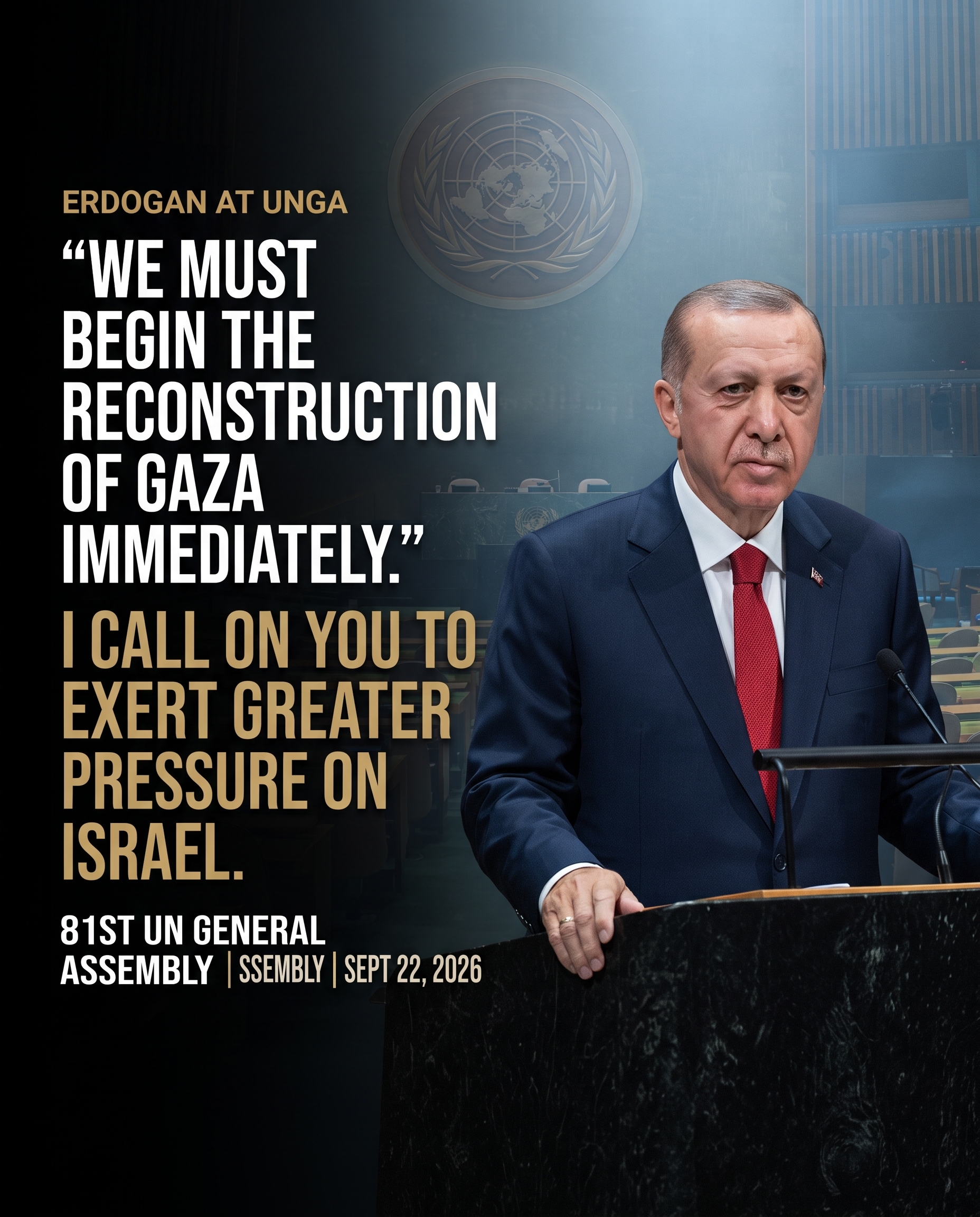
Erdogan’s address focused heavily on the humanitarian catastrophe in Gaza. He called for reconstruction to begin immediately and urged world leaders to put greater pressure on Israel (Anadolu Ajansı, 2026). “We must begin the reconstruction of Gaza immediately,” he said. “I call on you to exert greater pressure on Israel” (SWI swissinfo.ch, 2026).
A Symbolic Absence and a Walkout
Erdogan noted that Palestinian President Mahmoud Abbas has been unable to attend the UNGA for two consecutive years. He said Turkey would continue to be “the voice of a free and sovereign state of Palestine” in Abbas’s absence (ANTARA News, 2026).
The speech drew a sharp response. The Israeli delegation, including Israel’s UN Ambassador Danny Danon, walked out during Erdogan’s remarks, while the Palestinian delegation applauded (Sina, 2026; Türkiye Gazetesi, 2026).
Erdogan was unsparing in his language. He described what he called “a genocidal mindset that can never get enough of killing,” adding that “no one with humanity, mercy or conscience can turn a blind eye” (Al Jazeera via Asia Pacific Report, 2026). He also noted that despite the October 2025 ceasefire, more than 1,300 civilians have been killed in Gaza (Al Jazeera via Asia Pacific Report, 2026).
The Numbers Behind the Rhetoric
Erdogan’s characterization of Gaza as a “children’s cemetery” is grounded in casualty figures reported consistently since the war began. Palestinian health authorities have reported over 73,000 people killed since October 2023, with more than 174,000 injured (Radio Algérienne, 2026; WAFA, 2026). UNICEF has reported that nine children were killed in a single week in September 2026 alone (Radio Algérienne, 2026).
A joint assessment by the UN, World Bank, and EU published in April 2026 painted a devastating picture. Recovery and reconstruction needs are estimated at $71.4 billion over the next decade, with $26.3 billion required in the first eighteen months (UNSCO, 2026). Physical infrastructure damage alone stands at $35.2 billion, with economic and social losses adding another $22.7 billion (United Nations in Palestine, 2026).
The human development impact is staggering: set back by 77 years. Over 371,000 housing units have been destroyed or damaged. More than half of hospitals are non-functional. Nearly all schools have been destroyed or damaged. The economy has contracted by 84 percent. 1.9 million people have been displaced, often multiple times (United Nations in Palestine, 2026; CCTV+, 2026).
Why This Resonates in Nigeria
Erdogan’s speech will likely find a receptive audience in Nigeria, where the Gaza conflict has been a persistent topic of public debate. In October 2025, Nigerian Senators Abdul Ningi and Muhammad Adamu Aliero openly expressed solidarity with the Palestinian people during a Senate session, with Ningi wearing a keffiyeh and chanting “Free Palestine” (Vanguard, 2025).
The Islamic Movement in Nigeria praised the senators’ action as “a commendable expression of conscience, justice, and humanity” (ABNA, 2026).
The Nigerian government has also had to respond directly to the regional instability. In March 2026, the Nigerian Christian Pilgrim Commission suspended all pilgrimages to Israel, citing the security situation and a state of emergency declared by Israeli authorities (The Sun Nigeria, 2026; New Telegraph, 2026). Over 4,000 Nigerian pilgrims had completed the 2025 exercise without incident, but the Commission said safety remained non-negotiable (Sputnik Africa, 2026).
The UN Reform Call
Erdogan did not limit his criticism to Israel. He used the speech to call for fundamental reform of the UN Security Council, describing the current system as one “in which the will of more than 190 countries depends on the whims of five countries” (Ukrinform, 2026).
In an article published in Bloomberg Opinion, Erdogan argued that “the abolition of the veto privilege should be both the starting point and the fundamental strategic goal of any meaningful reform” (Ukrinform, 2026; ANTARA News, 2026).
His proposal goes further than most reform discussions. He suggested eliminating permanent membership entirely, with all Security Council members elected by the General Assembly for fixed terms, subject to re-election (RRI, 2026).
“We cannot build the international order of the future while preserving the hierarchies of the past,” Erdogan wrote. “The events of the last quarter-century have demonstrated that no balance of power and no international order is permanent” (Ukrinform, 2026).
A Broader Diplomatic Push
Erdogan’s address was part of a wider Turkish diplomatic effort at UNGA. He also called on countries that have not yet recognized Palestine to reconsider their stance (Anadolu Ajansı, 2026). The message found resonance beyond the Arab world. Former UN official Salman Shaikh, speaking on Al Jazeera, said simply: “Erdogan is absolutely right,” describing the situation in Gaza as “very, very dire” and emphasizing that “we can’t let what is happening in Gaza and the occupied West Bank become a normalised situation” (Al Jazeera via Asia Pacific Report, 2026).
Whether Erdogan’s call for reconstruction will translate into action remains uncertain. The UN assessment notes that recovery requires a sustained ceasefire, unimpeded humanitarian access, free movement of people and materials, clear and accountable governance, and a credible pathway for Palestinian Authority governance across the entire occupied territory (United Nations in Palestine, 2026). None of those conditions are currently in place.
For now, what remains is the rhetoric and the numbers. And the children.