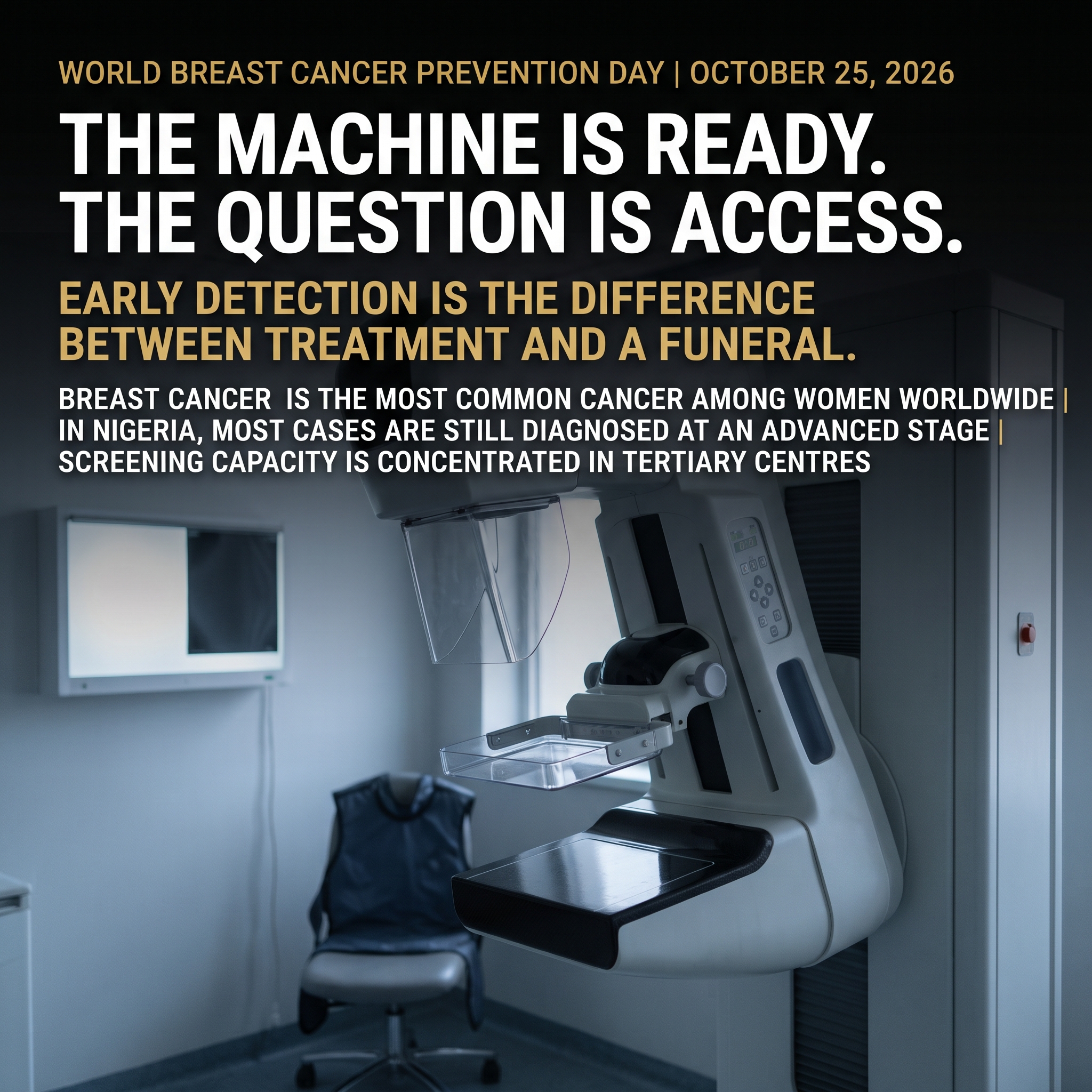
October 25 is World Breast Cancer Prevention Day. In Nigeria, it arrives at the tail end of Pink October, a month of walks, ribbons, and social media posts. The awareness is loud. The outcomes are not.
Breast cancer is the most commonly diagnosed cancer among Nigerian women and a leading cause of cancer death. The national burden continues to grow amid late presentation, limited organised screening, and fragmented pathways to diagnosis and treatment. Over 70% of Nigerian women with breast cancer present with advanced disease, when curative options are limited and survival is poor. The five-year survival rate in Nigeria is 44%. In the United States, it is 90% .
That gap is not biological. It is structural. And closing it requires moving past awareness into the harder work of prevention, screening, and timely treatment.
The Global Picture
In 2024, an estimated 2.4 million women were diagnosed with breast cancer worldwide, and 694,000 died from the disease. Breast cancer was the most common cancer in women in 164 of 186 countries. Around 80% of breast cancers occur in women with no specific risk factors other than sex and age. Most women diagnosed do not have a known family history of the disease .
But where a woman lives determines whether she survives. Between 2017 and 2021, the global median five-year net survival rate for breast cancer was 77.8%. In high-income countries, it was 87.3%. In lower-middle-income countries, it fell to 60.1%. In low-income countries, it dropped to 41.9% . These differences do not reflect variations in cancer biology. They mirror inequities in healthcare infrastructure, clinical awareness, and access to diagnostic imaging, biopsy, and timely treatment .
The World Health Organization’s Global Breast Cancer Initiative aims to reduce annual breast cancer mortality by 2.5%, which would avert an estimated 2.5 million deaths over 20 years. Its central target is to ensure that at least 60% of invasive breast cancers are diagnosed at Stages I or II . On October 19, 2026, the WHO released an operational training manual under the initiative, designed to help healthcare directors, clinicians, and public health partners strengthen screening, clinical assessment, and rapid-referral systems, particularly in low- and middle-income regions where advanced-stage presentation remains pervasive .
Prevention: What the Evidence Actually Says
There is no single way to prevent breast cancer. But there are evidence-based steps that reduce risk, and they are not the ones that get the most attention.
Alcohol is clearly linked to increased risk. Women who have one alcoholic drink a day have a small, roughly 7% to 10%, increase in risk compared with those who do not drink. Women who have two to three drinks a day have about a 20% higher risk. The American Cancer Society’s guidance is straightforward: it is best not to drink alcohol. Women who do drink should have no more than one drink a day .
Excess body weight after menopause increases risk. After menopause, most estrogen comes from fat tissue, and having more fat tissue raises estrogen levels. Women who gain weight as adults also face higher postmenopausal risk. The recommendation is to stay at a healthy weight throughout life and avoid excess weight gain by balancing food and drink intake with physical activity .
Physical activity reduces risk, especially in women past menopause. Even a couple of hours a week may be helpful, though more is better. The American Cancer Society recommends 150 to 300 minutes of moderate-intensity activity or 75 to 150 minutes of vigorous activity each week, or a combination of both .
Reproductive history matters. Women who have not had children, or who had their first child after age 30, have a slightly higher risk overall. Having many pregnancies and becoming pregnant at a young age reduces risk. Breastfeeding may also slightly lower risk, especially if it continues for a year or more .
These are not guarantees. They are risk modifiers. And for the roughly 80% of women who develop breast cancer without any known risk factor beyond sex and age, prevention messaging alone is not enough. That is why screening matters.
Screening: The Guidelines and the Gaps
Screening aims to detect cancer before symptoms appear, when treatment is more effective. The evidence supports mammography, but the guidelines differ on when to start, when to stop, and how often to screen.
The WHO supports organised mammography screening programmes in settings with sufficient resources, quality assurance, and follow-up capacity. Its recommendations broadly align with European practice: screening every two years for women aged 50 to 69 in well-resourced settings. In resource-limited settings, clinical breast examination can be used as a screening tool .
The U.S. Preventive Services Task Force updated its guidance in 2024 to recommend biennial screening starting at age 40 through age 74. The UK NHS invites women every three years from 50 to 71. The American Cancer Society recommends annual mammography from 45 to 54, then biennial or annual from 55 onward, with the option to start at 40 based on individual preference and risk factors. The European guidelines generally recommend screening from 50 to 69 every two to three years, with a conditional recommendation that some women aged 45 to 49 may benefit .
The disagreements reflect different weightings of the same evidence. Mammography reduces breast cancer mortality, with the largest absolute benefit in women aged 50 to 74. Benefits are smaller but still present for women in their 40s, at the cost of more false positives. Overdiagnosis, finding cancers that would never have caused harm, is a real but difficult-to-quantify harm. Different agencies weigh these trade-offs differently .
In Nigeria, the guidelines are almost academic. Organised population-based screening programmes are weak or absent in most of sub-Saharan Africa, with low coverage and reliance on opportunistic, fragmented screening. Access to diagnostic facilities is limited and predominantly urban. Cultural, religious, and socioeconomic barriers limit utilisation. Cost remains a significant barrier, with out-of-pocket expenses for diagnosis and treatment overwhelming for many households .
The mammography utilisation rate remains low in Nigeria, even among healthcare workers. The National Cancer Control Plan 2023–2027 includes the goal of establishing a national breast cancer screening programme, but implementation remains in the planning and early pilot stages, with no coordinated nationwide rollout to date .
What Nigeria Can Do
The WHO’s new training manual offers a practical framework. It is not theoretical. It focuses on standardised clinical breast examination by general practitioners, clinical officers, and community nurses; streamlined diagnostic pathways that integrate clinical findings with ultrasound, mammography, and core-needle biopsies without bureaucratic delays; and patient navigators who accompany individuals through complex referral chains, mitigating financial, logistical, and emotional attrition .
A convergent model is most feasible in Nigeria in the near term: anchoring breast health awareness, risk assessment, and clinical breast examination in primary care, with diagnostic mammography and ultrasound hubs in secondary and tertiary facilities. This is the approach proposed by Nigerian oncology researchers in a 2026 review, which also calls for measurable targets aligned with the WHO Global Breast Cancer Initiative to shift diagnosis to earlier stages and reduce mortality .
The technology exists to support this. AI-assisted imaging can help interpret mammography and histopathology, reducing reliance on scarce specialist expertise. Digital pathology allows remote slide review. Portable, smartphone-based platforms can decentralise screening and bring early detection closer to underserved communities . But technology alone will not close the gap. The barriers are cost, workforce, infrastructure, and political will.
The Action That Matters
Breast Cancer Prevention Day is not about ribbons. It is about the decisions women make before a diagnosis, and the systems that determine whether those decisions can be acted upon.
For individual women, the evidence is clear: limit alcohol, maintain a healthy weight, stay physically active, know your body, and seek care promptly if something changes. These are not dramatic interventions. They are sustainable ones.
For Nigeria, the work is harder. The country needs functional clinical breast examination at the primary care level. It needs affordable diagnostic imaging and biopsy. It needs treatment that does not bankrupt families. It needs a national screening programme that moves from paper to practice.
The WHO’s target is to diagnose 60% of invasive breast cancers at Stages I or II. Nigeria is nowhere near that. More than 70% of women present with advanced disease. Closing that gap is not a matter of awareness. It is a matter of access, investment, and the political decision to treat breast cancer as the public health emergency it already is.