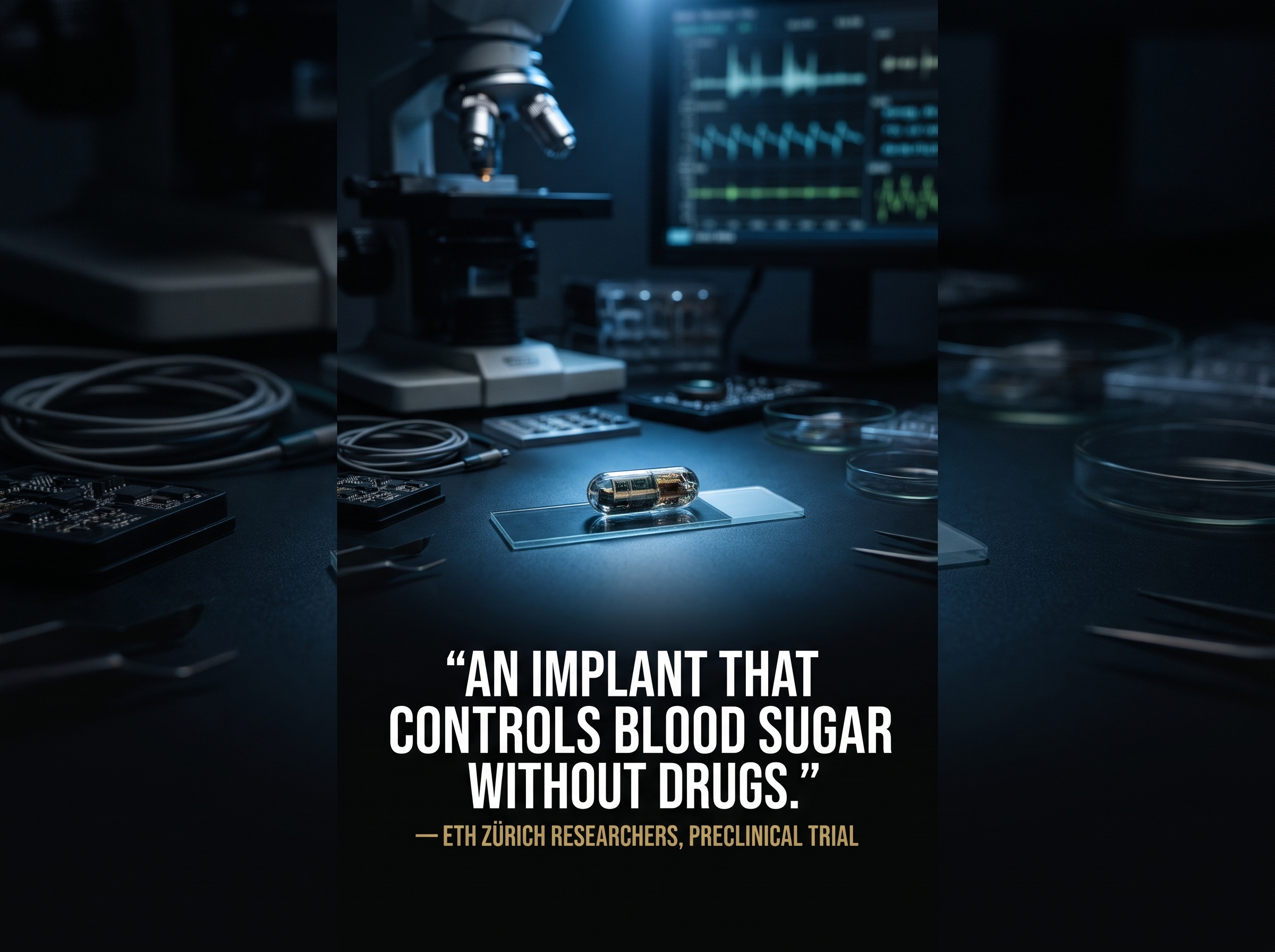
Researchers at ETH Zürich have developed a small implant that lowers blood sugar without insulin, without metformin, without any drug at all. It works by using electricity to chemically convert excess glucose in the blood into a substance the kidneys can easily flush out. In mice with type 2 diabetes and obesity, the device brought elevated blood sugar into the normal range within roughly an hour of being switched on, and kept it there for six weeks of repeated treatment (Science, 2026; Scientific American, 2026).
The device is called ECHO, which stands for electrocatalytic closed-loop health optimisation. It is roughly the size of a USB stick, sits just under the skin, and is powered wirelessly. It has not been tested in humans. But the preclinical results, published in Science on October 22, 2026, point to a genuinely different way of thinking about diabetes management: instead of using drugs to tell the body what to do with glucose, simply remove the excess glucose directly.
How It Works
The core of the device is a catalyst: platinum-decorated gold nanoclusters embedded in a porous graphite felt matrix (Science, 2026). When a low voltage is applied, about 0.75 volts and 10 milliamperes, less than half the power of a typical pacemaker, the catalyst accelerates a reaction that oxidises glucose into gluconate (C&EN, 2026).
Gluconate is a metabolite the body already handles. Some of it is burned for energy, and the rest is excreted through the kidneys (Scientific American, 2026). The reaction does not produce acidosis, and it is selective. The researchers tested the catalyst against 24 other metabolites, biomolecules, and drugs, including fructose, galactose, and lactose, which are structurally similar to glucose. The implant ignored them all (C&EN, 2026).
Martin Fussenegger, the study’s senior author, admitted the specificity was not designed. “We have no functional or structural explanation for that,” he said. “The specificity is, I would say, a lucky strike” (Scientific American, 2026).
The Closed-Loop System
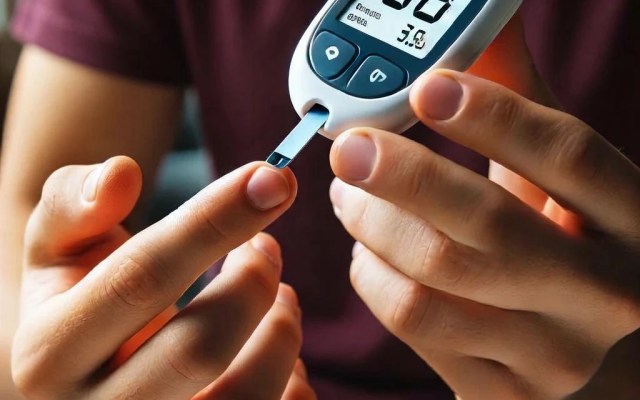
The ECHO implant is not meant to run continuously. It is designed to work with a continuous glucose monitor, the kind already used by millions of people with diabetes. When the monitor detects that blood sugar has risen above a pre-set threshold, it signals the implant to switch on. When glucose falls back into range, the implant switches off (Science, 2026).
In the mouse experiments, the team linked the implant to a commercial glucose monitor via a smartphone. For two weeks, the system ran autonomously, with no human involvement, turning the catalyst on and off as needed (Scientific American, 2026). That closed-loop operation is the key to safety: it reduces the risk of overshooting and driving blood sugar too low, a constant concern with insulin therapy.
What Happened in the Mice
The mice used in the study had “diabesity,” the combination of type 2 diabetes and obesity that affects more than 2.5 billion people worldwide (Science, 2026). After implantation, wireless activation restored normal blood glucose within about an hour. Repeated treatment maintained glucose control for six weeks without detectable hypoglycaemia (Science, 2026).
The metabolic effects went beyond glucose. Treated mice shifted their whole-body metabolism toward burning stored fat. They had lower circulating triglycerides, increased free fatty acids and ketone bodies, and they lost weight (Science, 2026). The device itself remained functional throughout the six-week period. There were no detectable adverse physiological, inflammatory, or behavioural effects. Implants removed after six weeks still worked, and some remained active after three months under the skin (Scientific American, 2026).
That last detail matters. Many implantable glucose devices rely on encapsulated cells that secrete therapeutic proteins, and those tend to fail because scar tissue seals them off from the body. ECHO showed no scarring and no leached metal in the surrounding tissue (Scientific American, 2026).
Why It Is Still Preclinical
The gap between a mouse and a human is not just a matter of scale, though scale is part of it. A mouse has roughly two millilitres of blood. A human has about five litres (Scientific American, 2026). The device would need to process a vastly larger volume of blood at a rate fast enough to matter after a meal. That requires miniaturisation, more efficient catalysis, and reliable wireless power delivery at a scale that has not yet been demonstrated.
There are also unresolved safety questions. The implant relies entirely on the kidneys to excrete gluconate. Chronic kidney disease is a common complication of long-term diabetes, and researchers have noted that excreting large volumes of gluconate could place undue strain on already compromised kidneys (Health and Family, 2026). Long-term tissue compatibility, the risk of infection from the implantation procedure, and the reliability of the wireless data link are all open questions (Particle, 2026).
And there is a fundamental limitation in the mouse model. The study was conducted in mice with type 2 diabetes. It does not address type 1 diabetes, where the body cannot produce insulin at all. ECHO removes glucose, but it does not replace insulin’s role in regulating fat metabolism and other physiological processes. It is a glucose sink, not a pancreas.
What It Could Mean for Nigeria
Nigeria has one of the fastest-growing diabetes burdens in Africa. The Endocrine and Metabolism Society of Nigeria estimates that about 11 million Nigerians are living with the condition (Healthwise, 2026). For many of them, the daily reality is not a choice between different treatment options. It is a struggle to afford the one that keeps them alive.
Insulin prices in Nigeria have risen from about ₦5,000 to roughly ₦25,000 per vial. Many patients need two vials a month, putting the monthly cost of insulin alone at around ₦50,000, before needles, test strips, and clinic visits (Pulse, 2026). In a country where millions live below the poverty line, that is not a treatment plan. It is an impossible arithmetic.
The ECHO device, if it ever reaches clinical use and is manufactured at scale, would not eliminate the need for monitoring or medical care. But it points toward a future where glucose control is not a recurring pharmaceutical expense. It is a one-time intervention, powered by a wireless signal, with no monthly drug bill. That is a radical departure from the economics of diabetes care. It is also, for now, a distant one.
The Bottom Line
ECHO is not a cure. It is not available. It has never been tried in a human. The path from a mouse with a subcutaneous chip to a patient in Lagos or Lagos, Switzerland, is long, expensive, and uncertain.
But the principle is sound, and the mouse data is striking. Instead of using drugs to manage a metabolic problem, the device removes the problem directly. It is a different kind of engineering, and it opens a door that has been closed for as long as diabetes has been treated with injections and pills.
For now, the advice remains unchanged. If you have diabetes, do not stop your medication. Do not wait for an implant. Talk to your doctor. But watch this space. The science is moving.