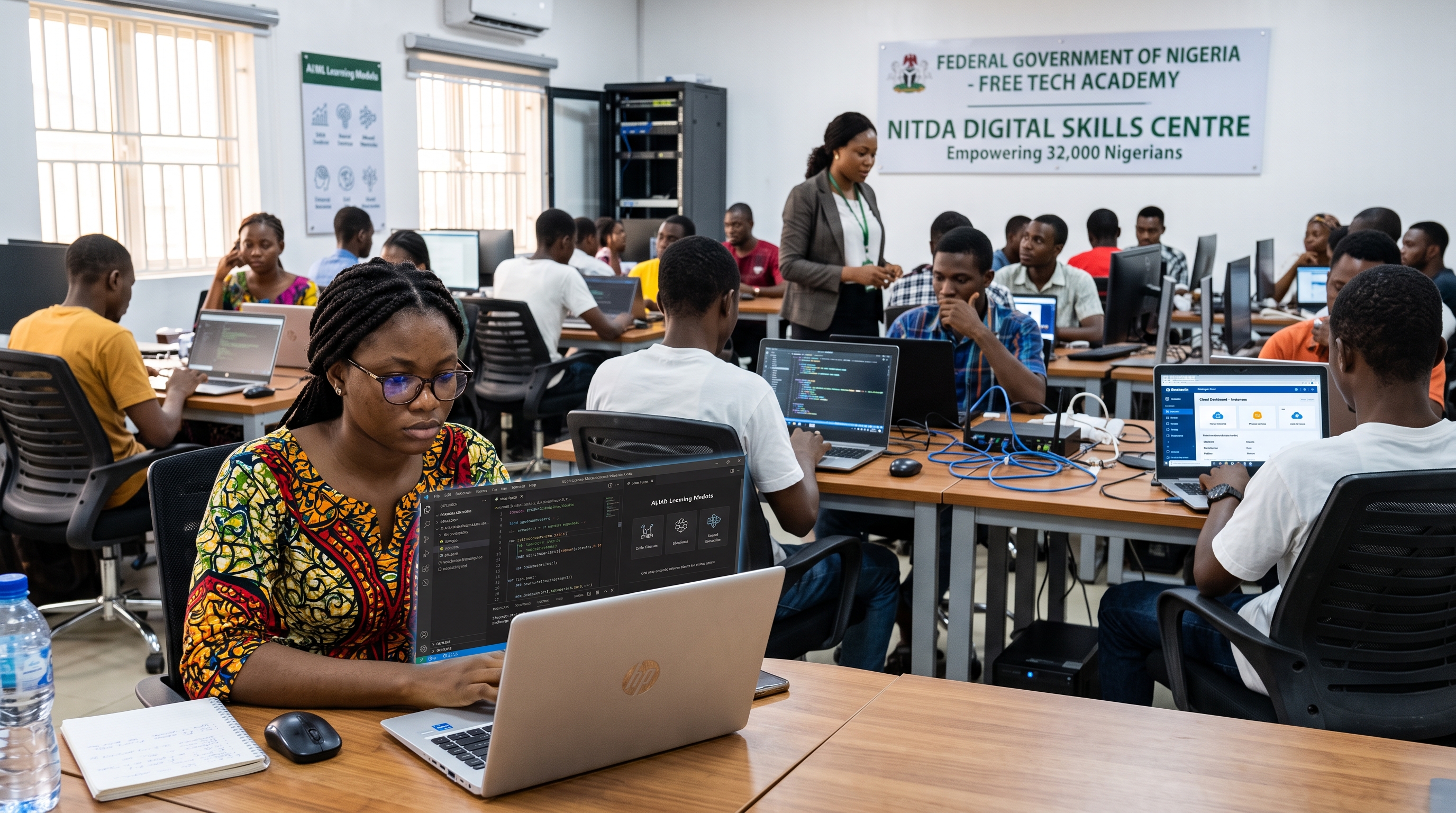
The Federal Government has committed over N10.5 billion to a new Digital Training Academy (DTA) aimed at equipping 32,000 Nigerians with globally recognised digital certifications. The programme, launched in Abuja on September 14, 2026, is being implemented under the Nigeria Education Sector Renewal Initiative (NESRI) and is part of President Bola Tinubu’s Renewed Hope Agenda. (BusinessDay)
What the Academy Offers
Minister of Education Dr Tunji Alausa described the academy as more than an online learning portal. “We are connecting talent to world-class learning, learning to certification, and certification to productive work, enterprise and national development,” he said at the launch. (Tribune)
The programme is being delivered in partnership with global learning platforms Coursera and Pluralsight, with certification pathways involving technology companies such as IBM, Google, AWS and Huawei. (BusinessDay)
Beneficiaries will receive six months of free training in high-demand fields including artificial intelligence and machine learning, cybersecurity, cloud computing, software development, IT automation, natural language processing, fintech, product management and quantum computing. (Channels TV)
The government has partnered with the National Open University of Nigeria (NOUN) and Yaba College of Technology (YABATECH) to establish access centres equipped with internet connectivity and learning devices across all 36 states and the Federal Capital Territory. (Guardian Nigeria) This addresses a critical barrier: many Nigerians have the aptitude but lack the devices or reliable internet access to participate in online learning.

How the Programme Works
The learner journey begins with registration using a National Identification Number (NIN), followed by profiling, a pre-assessment and placement on an appropriate learning pathway. (Vanguard)
The Economics Behind It
The economics behind the programme are straightforward. Alausa cited approximately 185,000 global job vacancies in software development, 111,000 in cybersecurity, and 68,000 in AI and machine learning, with total opportunities across the identified fields reaching about 2.2 million. “All these 2.2 million job vacancies are jobs that Nigerians can sit in their homes in this country and get paid decently, $3,000, $4,000 a month,” he said. (BusinessDay)
Building on Existing Programmes
This is not Nigeria’s first large-scale digital skills initiative. The 3 Million Technical Talent (3MTT) programme, run by the Ministry of Communications and Digital Economy, has been training Nigerians since 2023. The DTA is designed to complement 3MTT by providing a certification pathway for its beneficiaries. (Digital Watch Observatory)
The DTA also links to the National Talent Export Programme (NATEP), which aims to create one million export-linked digital jobs by 2027. Minister of Industry, Trade and Investment Dr Jumoke Oduwole said NATEP’s “Hire from Nigeria” platform will connect DTA graduates to international employers. (ThisDay)
Demand Outstrips Supply
The first cohort of 16,000 Nigerians was selected from 72,850 applications received between August 17 and September 1, 2026. (Channels TV) That means only about 22% of applicants secured a place. The demand is clearly there, but the supply of opportunities remains limited.
From Certification to Employment
There are legitimate questions about whether certification alone translates to employment. Alausa acknowledged this, saying “the true value of the Academy will not be measured by numbers alone,” but by graduates securing meaningful work, teachers integrating technology more effectively, and young Nigerians building tech-driven businesses. (Newswatch Nigeria)
For Nigerian developers and job seekers, the DTA represents a genuine opportunity to earn internationally recognised credentials without paying the often prohibitive costs of platforms like Coursera and Pluralsight. The access centres address the device and connectivity gap that has historically excluded poorer Nigerians from online learning.
But the programme’s success will depend on execution. Certificates from IBM, Google and AWS carry weight in the global job market, but they are not a guarantee of employment. The Nigerian labour market is saturated, and remote work opportunities are competitive. The government’s role should extend beyond training to actively facilitating job placement and entrepreneurship support.
The Bottom Line
The DTA is a meaningful investment in Nigeria’s digital future. Whether it becomes a pipeline to global opportunity or another certificate mill will depend on what happens after the six months of training end.