The Independent National Electoral Commission is quietly assembling a new kind of election infrastructure. Not ballot boxes or result sheets, but algorithms, threat models, and cybersecurity frameworks.
In September 2026, INEC Chairman Prof. Joash Ojo Amupitan led a delegation to the Global Conference on Responsible AI and Elections in Ottawa, Canada. There, the commission held strategic meetings with Google, Microsoft, and the International Foundation for Electoral Systems. The discussions covered emerging technologies, cybersecurity, and the responsible deployment of artificial intelligence in electoral processes. (ITWeb Africa).
This is not just a courtesy visit. It is a signal that Nigeria’s electoral body is preparing for a contest that will be fought as much in the digital space as at the polling unit.
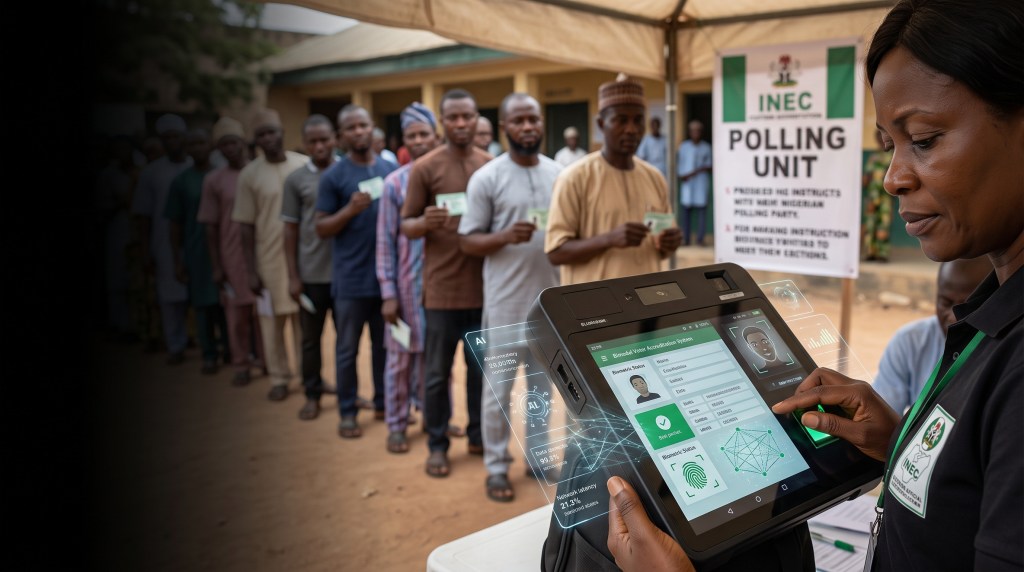
The commission’s interest in artificial intelligence is not an academic exercise. Nigeria’s electoral scale is staggering. With over 93 million registered voters, approximately 180,000 polling units, and about 185,000 BVAS devices, elections are conducted simultaneously across 36 states and the Federal Capital Territory. Manual oversight of that volume is impossible. (Vanguard).
INEC has already introduced an intelligent results management process designed to help officials identify discrepancies in election result records. This is not about AI making decisions. It is about AI processing the flood of data from the field faster than human eyes can. Amupitan has been explicit: “AI must strengthen electoral integrity, improve public service, and always remain under human control.” (Guardian Nigeria).
The commission has established a dedicated Artificial Intelligence Division within its ICT Department, developed an AI Roadmap for phased adoption, and is finalising an AI Governance Framework. It is also exploring AI-powered citizen services, including intelligent voter information tools and AI-assisted responses to frequently asked questions. (Tribune).
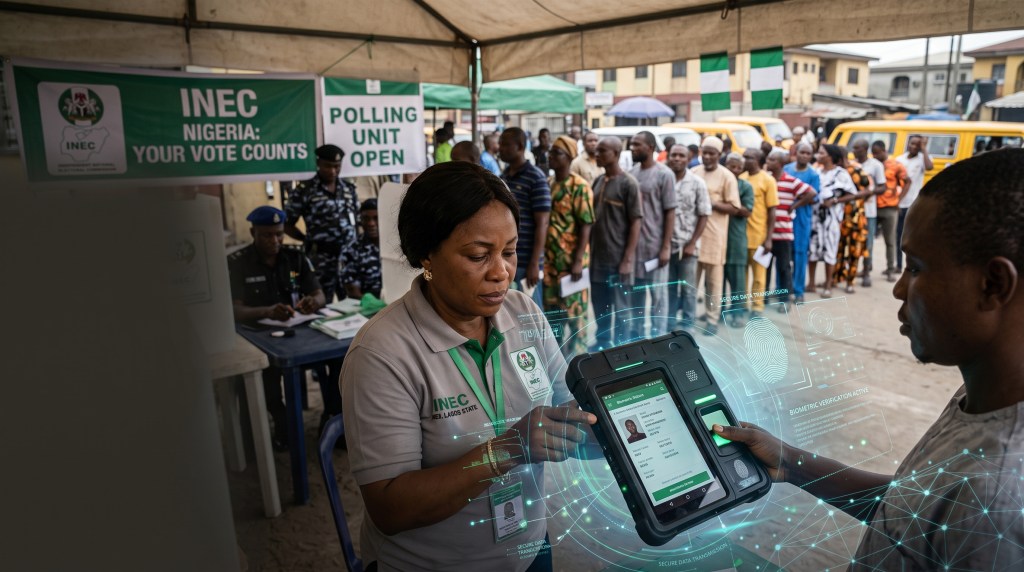
But alongside the potential of AI comes an uncomfortable conversation about vulnerabilities. Cybersecurity experts have warned that the BVAS devices currently run on Android 10, an operating system released in 2019. Oluwatobi Ayodele, a cybersecurity expert, called the continued use of the ageing platform a national security concern, warning that AI models are now capable of breaking through secure sandboxes and attacking external systems. (Newswatch Nigeria).
INEC’s Director of ICT, Dr Lawrence Bayode, has confirmed the commission has no immediate plan to upgrade the operating system. INEC has instead undertaken comprehensive reviews of its cybersecurity architecture, data systems, penetration testing protocols, and disaster recovery mechanisms. Whether that is enough remains an open question. (Newswatch Nigeria).
The threat is not hypothetical. In January 2026, former Oyo State First Lady Florence Ajimobi denied a viral video purportedly showing her making controversial comments. Her office said a forensic review identified the footage as AI-generated, with manipulated lip movements and cloned voice patterns. During the June 2026 Ekiti governorship election, CDD Fact Check identified an AI-generated image falsely presented as showing voters waiting to sell their votes. (Guardian Nigeria).
Bloomwit Africa’s report, Navigating Nigeria 2027, warns that the next general election will be the first in Nigeria’s history to take place with generative AI tools in wide circulation. The report notes that AI-generated disinformation, deepfakes, and political profiling have already been identified as threats. (Vanguard).
There is also the “liar’s dividend” problem. As synthetic media becomes more common, genuine recordings and photographs can be dismissed as fake. A politician caught on tape making a controversial statement can simply claim it was AI-generated.
The Digital Rights Lawyers Initiative has called for independent audits of Nigeria’s electoral technology and stronger privacy safeguards. The concern is legitimate. Voter data at this scale, processed by AI systems, requires protections that go beyond policy commitments.
For the average voter, the most immediate change will not be AI deciding who wins. It will be the information environment around them. Deepfakes of candidates, fabricated audio clips, and AI-generated images designed to suppress turnout or inflame ethnic tensions will circulate on WhatsApp, Facebook, and X. The 2027 election will test whether Nigerians can tell the difference between what is real and what is manufactured.
INEC’s five stated principles for AI adoption are sensible: human oversight, transparency and accountability, data protection and privacy, cybersecurity and risk management, and operational value and public trust. The commission has also outlined a legal framework anchored in the Constitution, the Electoral Act 2026, the Nigeria Data Protection Act 2023, and the Cybercrimes Act 2024. (Vanguard).
INEC’s AI literacy and technical capacity building programmes are aimed at its own staff, not the public. The commission needs a voter-facing counter-misinformation strategy that meets people where they are, on the platforms they actually use.
The honest answer is that Nigeria is building the framework while the threats are already arriving. INEC has demonstrated institutional awareness by establishing an AI Division and engaging global partners. It has not yet demonstrated that its cybersecurity architecture can withstand the kind of automated, AI-powered attacks that experts are warning about.
The mock accreditation exercise planned for November 2026 will be a critical test. It will show whether the BVAS devices hold up, whether the IReV portal can handle the load, and whether the systems that underpin Nigeria’s democracy are as resilient as the commission hopes.
Technology cannot fix a broken trust. But a poorly secured digital election can destroy what remains of it. The work INEC is doing now will determine which outcome Nigerians get in 2027.