
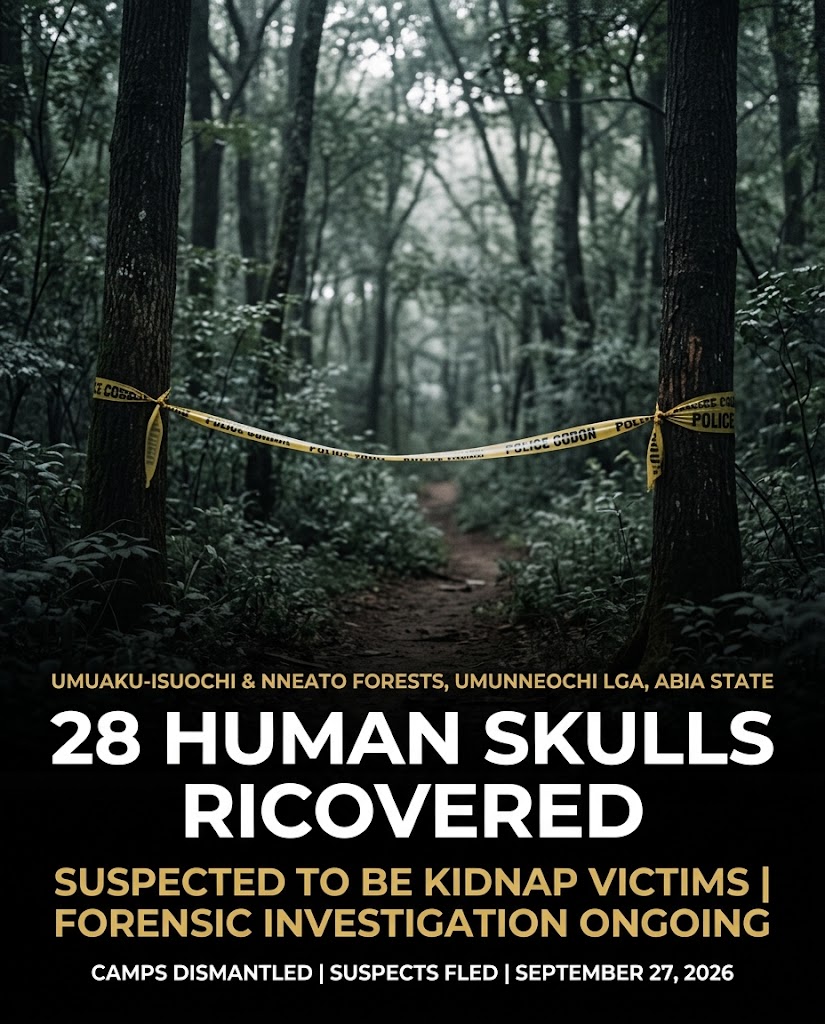
Police in southeastern Nigeria have recovered 28 human skulls and bones from suspected criminal camps hidden inside forests in Abia State, while separate mass abductions in the north left at least 87 people missing over the same weekend (BBC, 2026).
The remains were found on Saturday during a security operation in the Umuaku-Isuochi and Nneato forests of Umunneochi Local Government Area (The Cable, 2026). The raid followed intelligence reports about criminal activity in the area. When tactical operatives arrived at the camps, the suspects fled. The camps were subsequently dismantled.
Abia State Police spokeswoman Maureen Chinaka said in a statement: “Upon arrival of the Command’s tactical operatives at the camps, the suspects fled. The criminal camps were subsequently dismantled. A total of twenty-eight human skulls and bones, suspected to be kidnap victims, were recovered” (GBC Ghana, 2026).
The operation involved personnel from the violent crime response unit, anti-kidnapping unit, anti-cultism unit, intelligence response unit, rapid response squad, and Isuochi divisional police station (The Cable, 2026). Police suspect the remains belong to kidnapping victims, though forensic investigations are ongoing to establish their identities and the circumstances surrounding their deaths (BBC, 2026). Abia State Police Commissioner Wilfred Afolabi said the operation was part of an ongoing campaign to dismantle criminal hideouts in the state (GBC Ghana, 2026).
The discovery is likely to revive concerns about kidnapping gangs operating in remote forests across southeastern Nigeria, where criminal groups have frequently targeted motorists, travellers, and residents for ransom. Previous security raids in Umunneochi have uncovered decomposing bodies believed to be linked to kidnapping activities (BBC, 2026). The Umunneochi area has been a persistent flashpoint, with communities in Isuikwuato and Umunneochi repeatedly suffering attacks and abductions in recent years (Sahara Reporters, 2025).
Mass Abductions in the North
The same weekend brought devastating news from Nigeria’s northern states. At least 47 farmers were abducted by armed men while harvesting groundnuts in Rimi community, Mariga Local Government Area of Niger State, on Saturday (Newswatch Nigeria, 2026). A local source confirmed that heavily armed bandits stormed the farmlands and took the farmers, most of them women, to an unknown destination (Newswatch Nigeria, 2026).
The Mariga Local Government Chairman, Aliyu Bagga Muhammadu, later confirmed that one of the abducted farmers had given birth while in bandits’ captivity. The kidnappers demanded ₦94 million, or ₦2 million per victim, for their release (Naija News, 2026). Joint security teams had earlier engaged the bandits around the Kasuwan Garba and Beri axis, during which one vigilante member sustained injuries (Naija News, 2026).
In Zamfara State, about 40 women were kidnapped from Yargada community in Gusau Local Government Area on Sunday. Two security reports seen by AFP confirmed the abduction (Adnkronos, 2026). Residents said the attackers also launched coordinated assaults on nearby communities, setting houses ablaze and forcing many villagers to flee (Newswatch Nigeria, 2026).
One resident of Magama Mairake, Adamu Lawwali, told AFP: “The bandits have been burning houses since yesterday and the situation remains tense” (Newswatch Nigeria, 2026). Another resident, Umar Abdullahi, said the attack was believed to be a reprisal after local vigilantes allegedly killed several bandits during recent operations (Newswatch Nigeria, 2026).
A Kidnapping Economy
These incidents are not isolated. Kidnapping for ransom has become one of Nigeria’s most persistent security challenges, particularly across the northwest and north-central regions, where heavily armed gangs locally known as “bandits” operate across vast rural areas (BBC, 2026).
The economics are staggering. According to the 2026 edition of the Economics of Nigeria’s Kidnap Industry report by SBM Intelligence, no fewer than 7,825 people were abducted across 1,713 incidents between July 2025 and June 2026, a 66 per cent increase in victims over the previous cycle. At least 1,142 people were killed in the same period (Vanguard, 2026).
The report found that kidnappers collected ₦7.779 billion in ransom during the period, representing 34 per cent of the ₦22.856 billion demanded. The amount actually paid more than tripled from ₦2.56 billion in the previous cycle (Vanguard, 2026).
A single terrorist organisation accounted for 90 per cent of all ransom reportedly paid to kidnappers. The JAS faction of Boko Haram and allied cells recorded a 76.1 per cent collection rate from just eight incidents, demanding ₦9.205 billion and reportedly collecting ₦7.0015 billion. SBM attributed the high collection rate to the group’s capacity to carry out mass abductions and hold large numbers of hostages, giving it greater bargaining power than smaller criminal gangs (Vanguard, 2026).
The Human Cost
Behind the numbers are communities under siege. Farmers have struggled to access their farms because of insecurity, raising concerns about livelihoods and food production. For many affected communities in the North, the fear of abduction has become part of daily life (BBC Pidgin, 2026).
Niger State, which borders Nigeria’s capital Abuja, has witnessed numerous attacks in recent years, particularly in remote communities close to forests that serve as hideouts for armed groups. Mariga Local Government Area is among the worst affected (BBC Pidgin, 2026). Neighbouring Zamfara State is regarded as one of the hotspots of Nigeria’s banditry crisis. Despite military offensives and security operations, kidnappings and village raids continue across several local government areas (BBC Pidgin, 2026).
In Abia, the discovery of 28 skulls has left communities around Umunneochi in shock. The area’s forests have long been a concern, with criminal syndicates operating unchecked across isolated woodlands, routinely targeting passing motorists, commercial travellers, and rural residents (GBC Ghana, 2026).
Government Response
President Bola Tinubu has repeatedly warned bandits and kidnappers, stating that those who continue to threaten the country’s peace and security will face the full force of the law. He has declared that his administration will never negotiate with criminals or pay ransom, disclosing that criminal groups had demanded the release of detained gang members in addition to ransom during a recent kidnapping incident (Leadership, 2026).
“We refuse to negotiate for ransom. These criminals wanted us to release from detention members of their criminal gangs that were already arrested. That was one of their conditions, outside of the money they’re looking for, and we said no deal. We are not going to negotiate with criminals,” Tinubu said (Leadership, 2026).
The government has announced plans to expand the Nigerian Army from eight to 12 divisions to shorten response times, establish state police with safeguards against abuse, and strengthen the Forest Guard to pursue criminal gangs operating in forest reserves (Guardian Nigeria, 2026).
Tinubu also attributed part of Nigeria’s security challenges to instability in neighbouring Mali, Burkina Faso and the Niger Republic, saying the situation had intensified cross-border threats (Leadership, 2026).
In Abia, police have intensified surveillance in the area as officers search for the suspects who fled. Authorities have appealed to residents to report suspicious activity and security concerns as efforts continue to identify the victims and determine whether the remains are connected to unresolved kidnapping cases in the region (BBC, 2026).
The Human Rights Writers Association of Nigeria has called on South-East governors to unite against insecurity, citing the recovery of the 28 skulls as evidence of the gravity of the crisis (Leadership, 2026).
The challenge for federal and state authorities remains balancing aggressive military intervention with community-level intelligence and economic rehabilitation. As the weekend’s events have shown, the crisis spans both the forests of the southeast and the farmlands of the northwest, with no region immune to its reach.


