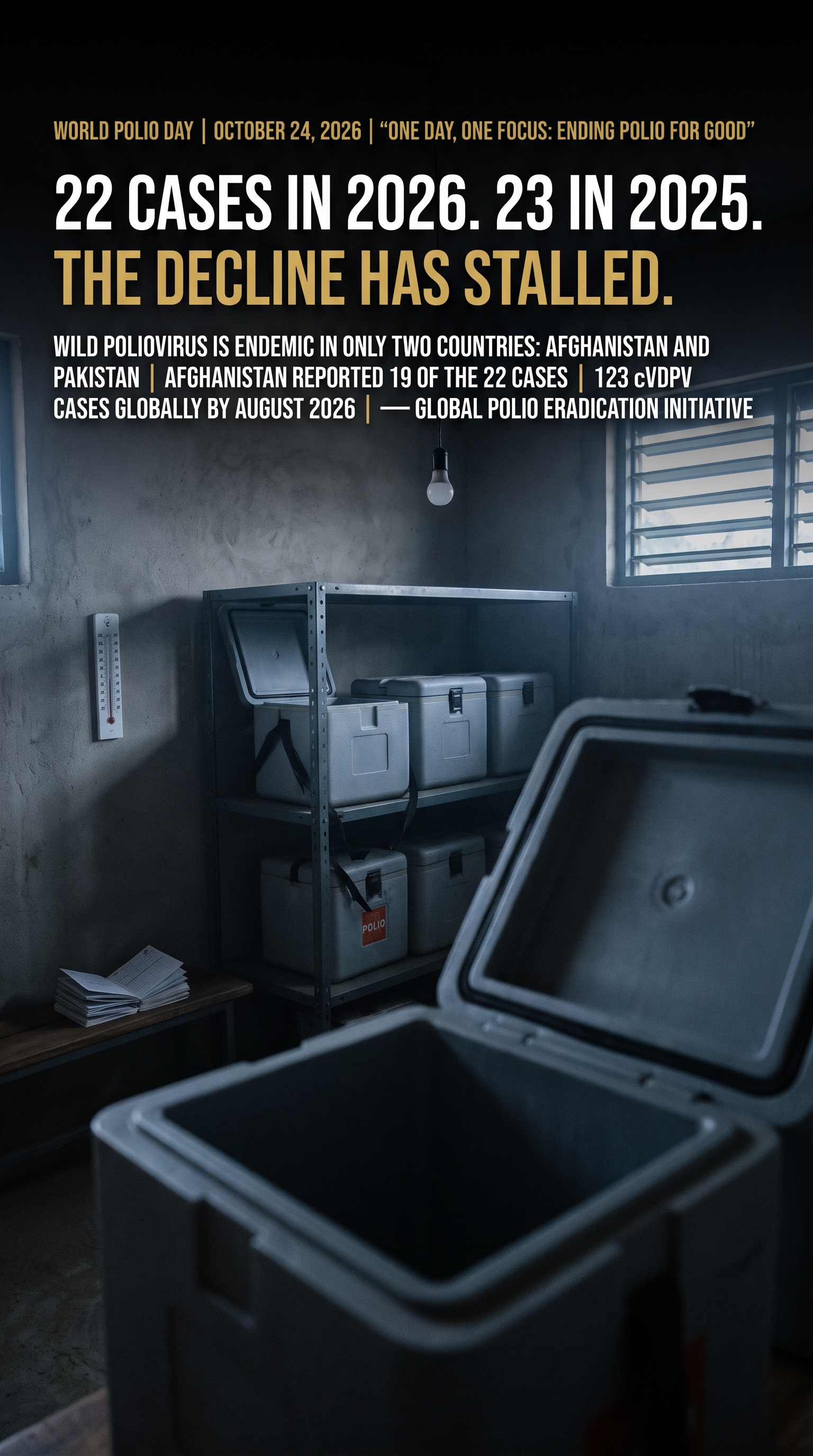
Every year on October 24, the world marks World Polio Day. The date honours the birth of Dr Jonas Salk, the man who developed the first polio vaccine. But this year, the day carries a different weight. The theme for 2026 is “One Day, One Focus: Ending Polio for Good,” a call to finish a job that has taken over four decades and billions of dollars to almost complete (WHO Africa, 2026).
The world is closer to eradicating polio than at any point in history. Wild poliovirus is now endemic in only two countries: Afghanistan and Pakistan. The African region was certified free of indigenous wild poliovirus in 2020. But the finish line is not the same as the end. The final stretch is the hardest, and it is defined not by science but by gaps in access, coverage, and political will (GPEI, 2026).
Where the World Stands
The progress is real. In 2025, the Global Polio Eradication Initiative immunised more than 350 million children multiple times, including over 55 million in Pakistan and Afghanistan (GPEI, 2026). Between January and September 2026, over 168 million children in the WHO African Region received at least one dose of polio vaccine through 55 campaign rounds across 22 countries (WHO Africa, 2026).
But the numbers also reveal the challenge. In 2026, as of late August, there were 22 wild poliovirus cases globally, almost unchanged from 23 at the same point in 2025. Afghanistan reported 19 of those cases, Pakistan three. Circulating vaccine-derived poliovirus (cVDPV) outbreaks, which occur when the weakened virus in the oral vaccine mutates and spreads in under-immunised populations, remain a persistent threat. By August 2026, 123 cVDPV cases had been reported globally, compared with 125 at the same point the previous year. The decline has stalled (GPEI, 2026).
The Independent Monitoring Board, in its 25th report published in October 2026, recognised progress in interrupting cVDPV outbreaks in five countries. But it also highlighted continued wild poliovirus transmission in Afghanistan and Pakistan beyond the timelines set out in the current strategy, with the epidemiological burden increasingly concentrated in Afghanistan. The report noted gaps in routine immunisation and surveillance, and the impact of a more constrained global financing environment (GPEI, 2026).
The Frontline Workers
Behind every vaccination campaign are people who walk into difficult, often dangerous, places to reach children who have never been reached before. In Pakistan, more than 400,000 frontline workers, including 60 per cent women, serve in the polio eradication programme. They work in difficult terrain and under security threats. More than 200 polio workers and police officers protecting them have been killed in Pakistan since the 1990s (Government of Pakistan, 2026; DW, 2026).
In Nigeria, the story is similar. Vaccinators in Kebbi, Sokoto, and Zamfara trek long distances across difficult terrain and harsh weather. They work during Ramadan and Lent, navigating security-compromised locations. Habib Salako, eHealth Africa’s Kebbi state coordinator, described the work as a service to humanity. “The joy of seeing children vaccinated is immense because when a child is vaccinated, we boost their immune system and help prevent future diseases,” he said. “That is the biggest reward and motivation to continue despite stress” (eHealth Africa, 2026).
But the risks are not just physical. Insecurity has brought fresh challenges. Gunmen have attacked polio clinics in Kano, killing people. In Borno, insecurity has prevented health officials from conducting immunisation campaigns in some areas. The Nigerian Medical Association has called on government at all levels to provide effective security posts in public health facilities (BusinessDay, 2026).
The Final Hurdles
The final push to eradicate polio is not a scientific problem. It is a problem of access, trust, and money.
Dr Razia Pendse of the WHO Director-General’s office put it plainly at the World Health Assembly in May 2026: “None of these gaps are scientific or technical — they are gaps in political will. Gaps in vaccination coverage, where children are still being missed. Gaps in access, where insecurity or instability limits our reach. And gaps in financing, where resources must match the urgency of the final push” (GPEI, 2026).
Funding is a critical constraint. A US$1.7 billion gap remains for 2026, and cuts to global health funding are causing health-worker shortages, clinic closures, and disruptions to routine childhood vaccination (UNICEF, 2026). In the WHO African Region, funding constraints are forcing campaigns to prioritise the highest-risk areas, leaving other vulnerable communities without sufficient protection. In the Democratic Republic of the Congo, additional vaccination rounds needed to respond to the type 2 outbreak remain unfunded (WHO Africa, 2026).
Vaccine hesitancy, fuelled by misinformation, is another barrier. In Benin, community health workers are working to restore trust in vaccination, one conversation at a time, after years of misinformation. In 2025, a campaign reached over 2.4 million children, thanks in part to the work of these “refusal managers” (GPEI, 2026).
Nigeria’s Critical Role
Nigeria is central to the global eradication effort. The country was certified free of wild poliovirus in 2020, but it continues to battle circulating variant poliovirus outbreaks. In 2026, Nigeria recorded 30 cases of cVDPV. Borno State, which has been the epicentre of the outbreak, has seen cases drop from eight in 2025 to three in 2026 (Radio Nigeria, 2026; Punch, 2026).
But the fight is not over. About 71.5 per cent of children in Borno State are yet to be fully vaccinated against polio, according to UNICEF. The state’s 10-day vaccination campaigns target over two million children, including those in hard-to-reach areas (UNICEF, 2026; Healthwise, 2026).
Nigeria has also strengthened regional capacity. The accreditation of the Maiduguri laboratory in 2026 has improved the speed of poliovirus detection and outbreak response. New technologies, including Direct Detection Nanopore Sequencing, are being piloted to reduce laboratory turnaround times (WHO Africa, 2026).
The infrastructure built through decades of polio campaigns is now strengthening routine immunisation. In Sokoto, the tools developed to reach every child with polio vaccines are helping protect children against a wider range of diseases (GPEI, 2026).
What Happens Next
The Global Polio Eradication Initiative has set a target to interrupt endemic wild poliovirus transmission in 2026 and stop cVDPV2 outbreaks by 2028. The Independent Monitoring Board has made 21 recommendations to accelerate progress, with an increased emphasis on accountability, clear ownership, and measurable delivery (GPEI, 2026).
But the finish line is not guaranteed. The remaining reservoirs are the hardest to access, the most politically complex, and the most unforgiving of operational gaps. As WHO Regional Director for Africa Dr Mohamed Janabi put it: “Reaching every child only once is also insufficient. Children need all recommended doses, supported by dependable routine immunisation services. Conflict and displacement can interrupt access, while distance and concerns about vaccines create further barriers” (WHO Africa, 2026).
World Polio Day 2026 is not a celebration of victory. It is a reminder of what is at stake. A disease that can be prevented is still paralysing children. The vaccine exists. The workers are willing. The only thing standing between the world and eradication is the will to finish the job.