
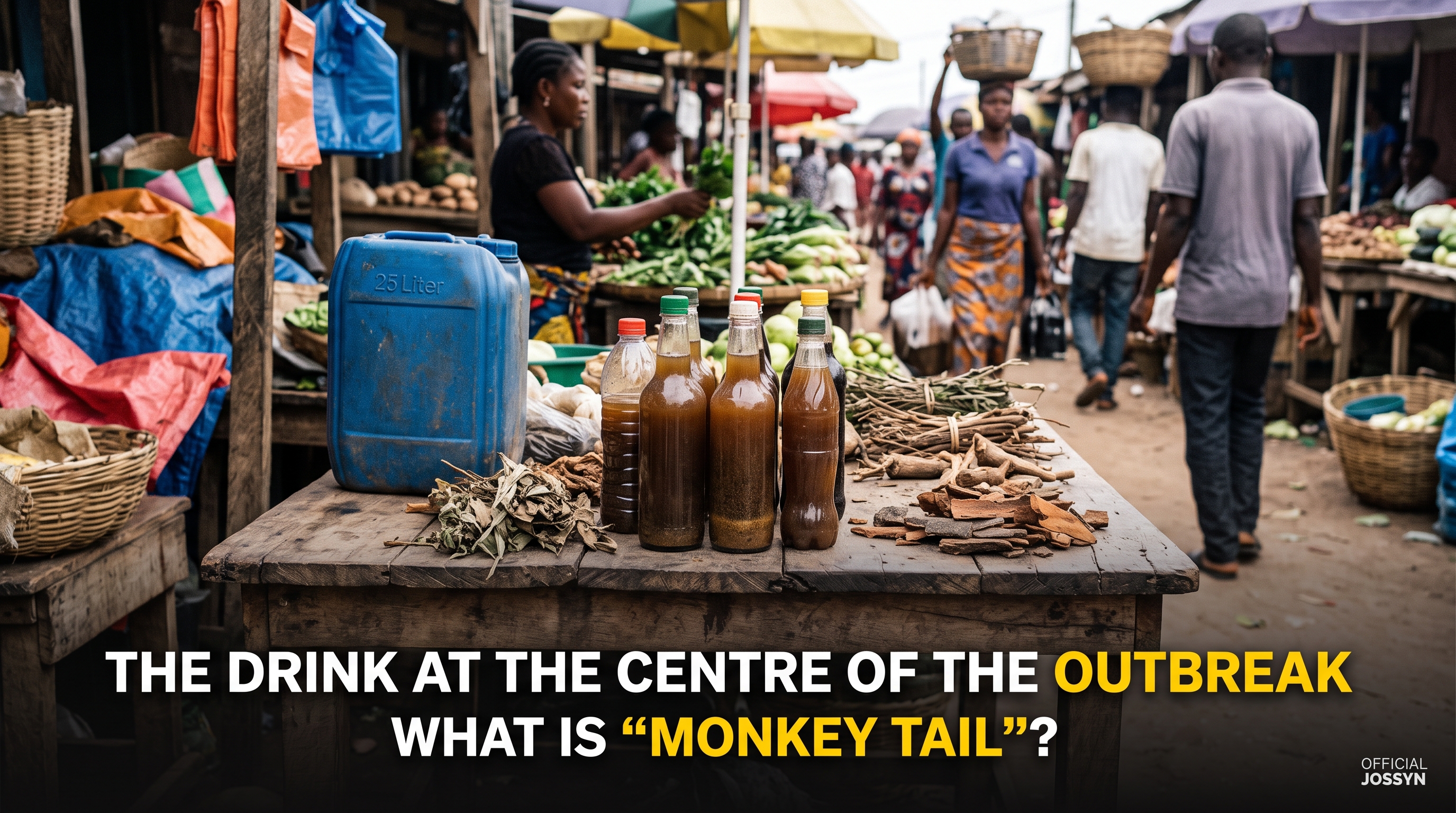
At least 48 people are dead in Ondo State. Around 100 others are receiving treatment in hospitals across Odigbo and Irele Local Government Areas. The state government has confirmed 182 cases so far, and police have arrested 15 people, including a suspected producer. The culprit, according to health officials, is methanol. A toxic form of alcohol that looks, smells and initially tastes like the real thing, but attacks the optic nerve and the brain with terrifying speed.
Commissioner for Health Dr Banji Ajaka put it bluntly to the Associated Press: “This thing happened rapidly. Once they consume, depending on the quantity, the kidneys will pack up, the eyes will go, the brain will be damaged” .
This is not a new story in Nigeria. It is a recurring one. And understanding why it keeps happening requires looking at the science, the economics, and the regulatory gap that allows it to continue.
The Drink Known as Monkey Tail
The suspected source is a locally produced herbal drink commonly called “Monkey Tail,” a mixture of herbs and ogogoro, the indigenous palm wine distillate consumed across southern Nigeria for generations .
One survivor, 32-year-old Shola Adebayo, drank two shots on the evening of September 5. He woke up the next morning unable to see. He is now in hospital, praying his sight will return. “If God saves me,” he told a reporter, “I swear I will never take any drinks again. Even beer, I won’t take” .
Among the dead are three siblings from the same family, erased in a single evening .
What Methanol Does to the Body
Ethanol is the alcohol in every legitimate alcoholic beverage. It is produced when yeast ferments sugar. Properly distilled ogogoro is ethanol and water .
Methanol, also known as methyl alcohol or industrial alcohol, is a different chemical entirely. It is found in windshield wiper fluid, industrial solvents, antifreeze and carburetor cleaner. It looks identical to ethanol. It smells similar. In the first few hours after consumption, it produces similar intoxication. A person who drinks methanol does not know they have been poisoned .
That latency is what makes it so deadly. The symptoms, including headache and dizziness, are indistinguishable from ordinary drunkenness. Victims often do not seek medical care until the methanol has already been metabolised by the liver into formaldehyde and formic acid. These compounds attack the optic nerve, causing blindness, and the central nervous system, causing brain damage and death .
The treatment is fomepizole or ethanol, which block the enzyme that converts methanol into its toxic byproducts, alongside dialysis to remove what has already formed. But by the time most victims reach a hospital in rural Ondo State, the window for effective treatment has often closed .
Why This Keeps Happening
The answer is economics, not malice. Methanol costs a fraction of the ethanol required to produce legitimate local spirits. Adding methanol increases the volume and the profit margin of a product that is already sold cheaply in informal markets .
This is not speculation. It is a pattern that has been documented repeatedly. In April and June 2015, 89 Nigerians died from methanol-contaminated ogogoro across Rivers and Ondo States. Laboratory analysis by the World Health Organization and NAFDAC found methanol concentrations of 16.3 percent in the beverages consumed, with blood methanol concentrations in victims ranging from 1,500 to 2,000 milligrams per litre. The case-fatality rate in the Ondo outbreak of that year alone was 73 percent .
In July 2023, eight people died and eleven suffered severe illness from adulterated ogogoro in Lagos State. The incidents form a pattern so well documented and so precisely repeated that calling them surprises is no longer defensible .
The Regulatory Gap
Two days before news broke that 24 people had died in Odigbo, NAFDAC Director-General Prof. Mojisola Adeyeye was in Abuja explaining, on the record, exactly why a product like this can circulate freely in the first place.
She said the agency does not have “direct and absolute regulatory oversight” over unbranded, traditionally packaged products sold in open markets. NAFDAC’s mandate is built around processed and packaged products: inspecting facilities, sampling, lab testing, monitoring compliance, recalling registered goods. Products sold loose, unbranded, and informally at open markets sit largely outside that machinery .
She urged state and local governments to “strengthen monitoring and enforcement within their jurisdictions” to cover the gap.
The local government’s response so far has been the standard reactive measure: a one-month ban on the sale and consumption of locally brewed drinks in the area, imposed after 24 people were already dead. Enforcement arrived at the only point it currently can, after the fact, following a mass casualty event .
What This Means for Nigerians
If you drink locally produced alcohol from informal sellers, you are taking a risk that no label, no seal, and no regulatory inspection has mitigated. That is not a moral judgment. It is the structural reality of a market where methanol is cheaper than ethanol and nobody is checking before people die .
The pattern will repeat unless the enforcement gap is closed. State and local governments have the constitutional responsibility for monitoring informal markets. The question is whether the political will exists to fund and staff that monitoring before the next batch kills another 48 people.
For now, the Ondo State Government has worked with NAFDAC, the World Health Organization, the National Drug Law Enforcement Agency, the Department of State Service, the Police and the Amotekun Corps to identify the source, contain the incident and prevent further deaths. Police have arrested Oloruntoba Babatunde, known as “Meko,” on suspicion of producing the substance, alongside 14 alleged sellers and consumers .
But arrests after the fact do not bring back the dead. They never have.


