U.S. President Donald Trump has warned that a proposal for Canada to become an associate member of the European Union could be regarded by Washington as a hostile act, raising the possibility of substantially higher U.S. tariffs on European goods and even restrictions on trade with Europe. The warning came on September 16, 2026, shortly after European Commission President Ursula von der Leyen proposed that Canada become the EU’s first associate member during her annual State of the Union address to the European Parliament in Strasbourg. The proposal represents a significant attempt to deepen European-Canadian cooperation at a time when relations between Canada and the United States have become increasingly contentious. (Reuters)
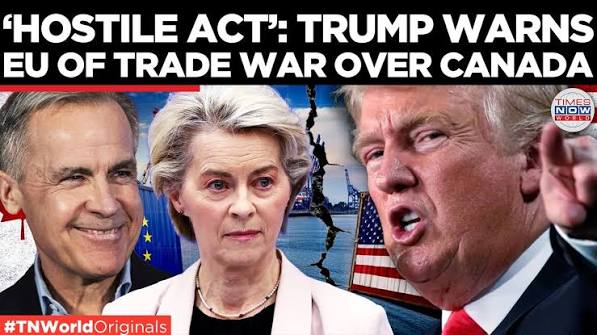
Speaking to reporters in Charlotte, North Carolina, Trump reacted sharply to the proposal. He described the prospect of Canada becoming associated with the EU as laughable and warned that Washington could respond if it concluded that the European initiative was intended to disadvantage the United States with an intentional tariff. He subsequently warned that Europe could face “very heavy tariffs” if the initiative were pursued with what he considered bad intentions. (Al Jazeera) thought Trump did not say that tariffs would automatically be imposed simply because Canada pursued closer relations with Europe. His comments were conditional on his assessment of the EU’s intentions. This distinction is important because the proposed associate-membership arrangement has not yet been finalized and its precise legal and economic structure remains unclear. (Al Jazeera). European Commission President Ursula von der Leyen introduced the idea during her September 16 State of the Union address. She proposed opening the way for Canada to become the EU’s first associate member, arguing that Europe and Canada share strategic interests in areas including: defence and security; artificial intelligence and technology; critical raw materials; energy; supply chains; climate policy; Arctic affairs; Ukraine and European security; and democratic institutions and international cooperation.
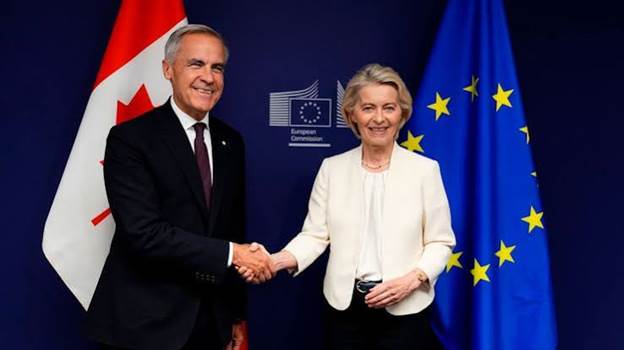
Von der Leyen presented the proposal as part of a broader effort to strengthen Europe’s partnerships in what she described as an increasingly unstable international environment. (Reuters). This proposal might also be seen as a diversification effort aimed to reduce the trade EU trade deficit with China, making the EU less dependent on Chinese raw materials. However, associate membership is not currently a standard EU status with a clearly defined set of rights and obligations under the EU treaties. Consequently, the precise meaning of Canadian associate membership remains to be negotiated. Moreover, reuters reported that some EU diplomats expressed uncertainty about the proposal because it is not yet clear what institutional or economic rights Canada would receive. The proposal would also require support from EU member states (MarketScreener). Also, Canada already has an extensive economic relationship with the EU through the Comprehensive Economic and Trade Agreement (CETA). However, the proposed arrangement would potentially go beyond conventional trade cooperation. Canadian Prime Minister Mark Carney welcomed the idea of developing a much stronger relationship with Europe, although his government has described the objective as a “unique alliance” rather than Canadian membership of the EU.

Canada is seeking to diversify its international economic and strategic relationships as tensions with Washington increase. Carney has previously promoted reducing Canada’s dependence on the United States and expanding Canada’s economic relationships with other partners. (Al Jazeera). The proposed Canada-EU relationship could therefore encompass areas that go beyond tariffs and merchandise trade, including: Canada–EU cooperation, Trade, Technology and AI, Critical minerals, Energy, Defence industries, Arctic security, Supply chains, Research and innovation, Ukraine support, Economic security. Canada has expressed an ambition to significantly increase its non-U.S. trade over the coming decade as it seeks greater economic diversification. (MarketScreener). European officials have pushed back against the suggestion that cooperation with Canada should be interpreted as an anti-American initiative. Von der Leyen explicitly presented the proposed partnership as a broader strategic relationship rather than an alliance designed against Washington. Reuters reported that she described the Canada-Europe partnership as not against anyone else (MarketScreener). France’s Europe Minister Benjamin Haddad also argued that the United States does not have authority over EU geopolitical decisions, according to Reuters. (Reuters).